Correction (October 11, 2026): Washington's Office of Superintendent of Public Instruction republished its attendance files on September 30, 2026, with recalculated counts. In the restated data, foster care students' chronic absenteeism rate was 40.2% in 2022-23, 40.3% in 2023-24 and 41.6% in 2024-25, so an earlier version's headline and description, which said the rate had plateaued at 41% for three years, have been changed: the rate held near 40% for two years and then rose. The earlier version also said foster care students had the lowest recovery rate of any major student group. That was wrong: Asian and Pacific Islander students have recovered less of their pandemic increase. Foster care students have the lowest recovery among the five vulnerable groups compared here. The article's other figures were restated to the new edition.
Every other vulnerable student group in Washington is making progress on chronic absenteeism, however slowly. Low-income students improved 3.4 points over two years. Students with disabilities improved 3.5 points. Even students who are currently homeless, with the highest rate of any subgroup, dropped 2.8 points.
Foster care students have not moved. Their chronic absenteeism rate was 40.2% in 2022-23, 40.3% in 2023-24, and 41.6% in 2024-25: two years of essentially identical numbers, then a rise. While the state recovered 5.5 points from its pandemic peak, foster youth recovered 4.0 points, and all of that recovery came in 2022-23. Since then, the rate has gone up, not down.
3,788 students, 1,575 chronically absent
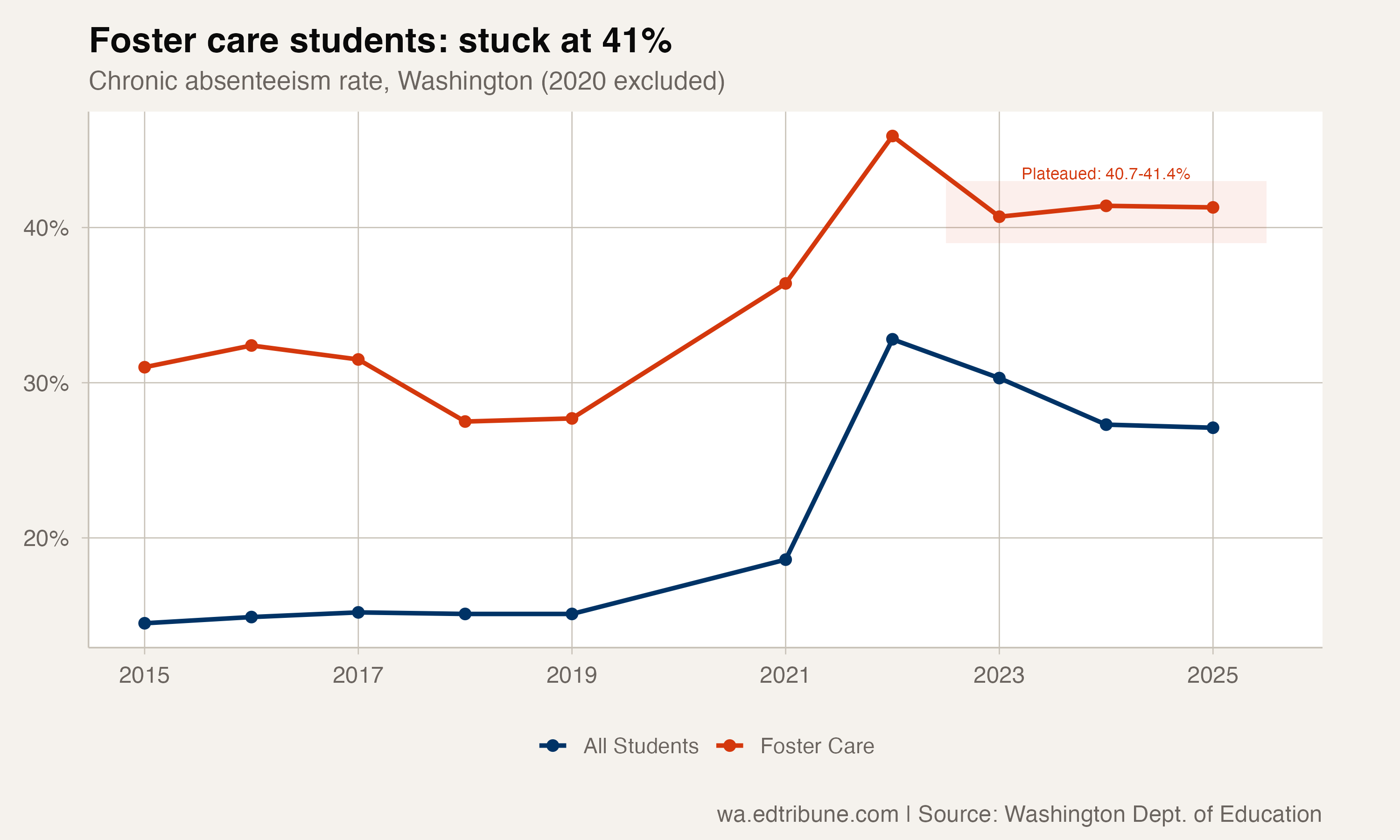
Washington's foster care student population has declined substantially, from 7,461 in 2018-19 to 3,788 in 2024-25, a 49% drop that reflects both a reduction in the state's foster care caseload and changes in how foster status is reported to schools. The smaller denominator means that the chronic rate represents a smaller total number of students: 1,575 foster youth were chronically absent in 2024-25, down from 2,225 at the 2022 peak.
But the persistence of a rate above 40% is what matters. Even as the population shrank, the share of foster students who miss a month of school did not come down. The students remaining in foster care are, if anything, the ones with the most entrenched barriers to attendance.
The plateau that other groups do not share
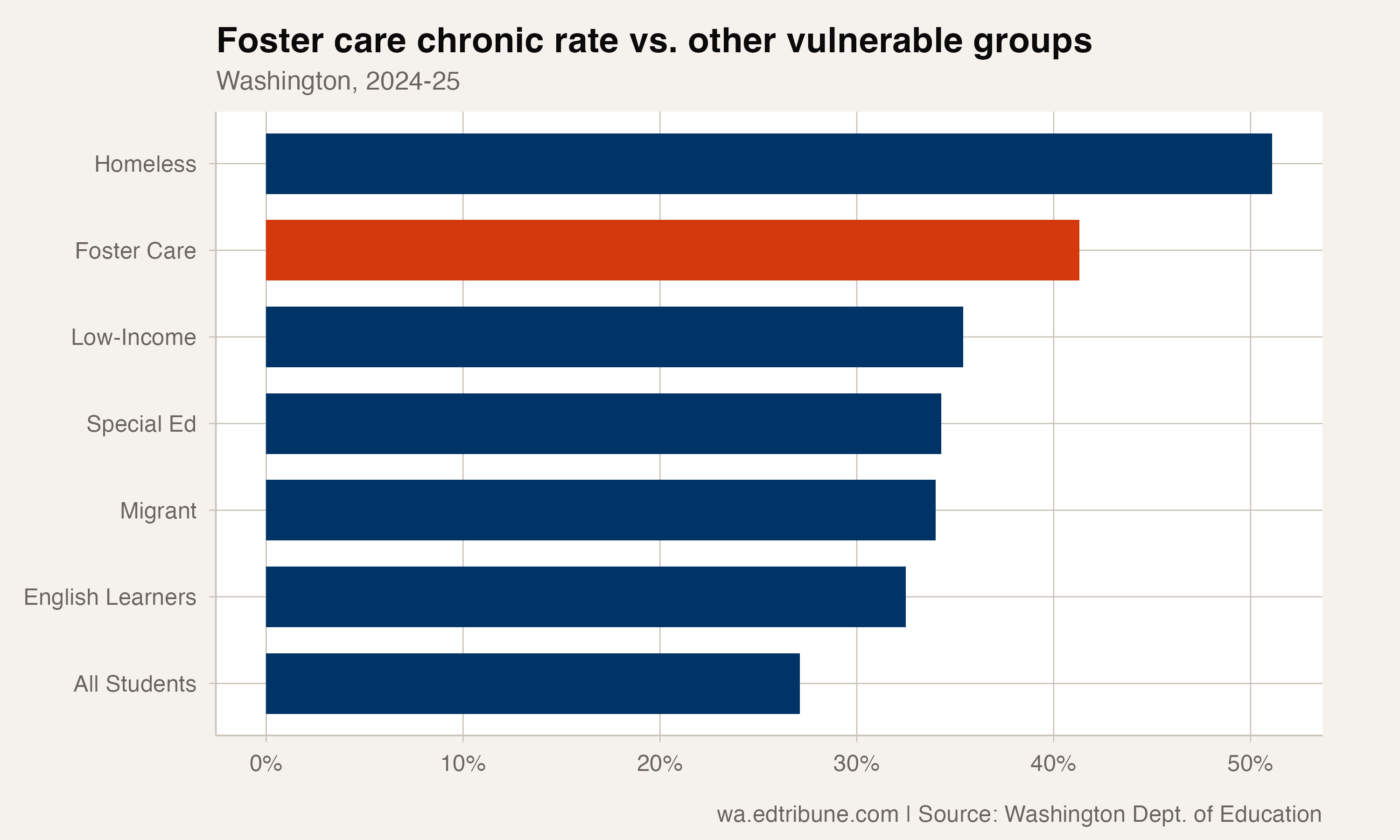
Foster care is the only major vulnerability subgroup in Washington where the chronic rate has not meaningfully declined since 2023. The comparison is sharp:
- Low-income students: 38.8% → 35.4% (down 3.4 points)
- Students with disabilities: 37.9% → 34.4% (down 3.5 points)
- Migrant students: 37.7% → 34.0% (down 3.7 points)
- Students who are currently homeless: 54.0% → 51.2% (down 2.8 points)
- Foster care: 40.2% → 41.6% (up 1.4 points)
Every other group improved. Foster care worsened. The divergence is not large enough in any single year to flag as statistically alarming, but three years without improvement, combined with improvement everywhere else, makes it structurally significant.
Why foster care is different
The fundamental challenge for foster youth attendance is placement instability. A student who changes foster homes also frequently changes schools. Each school change means new enrollment paperwork, new relationships with staff, a gap in instruction, and a disruption in the routine that makes regular attendance possible. Research from Treehouse, a Washington nonprofit focused on foster youth, finds that the average foster child in Washington changes schools at least once per year, and many change multiple times.
This is a barrier that the standard attendance interventions (reminder calls, incentive programs, transportation assistance) cannot address. You cannot fix the attendance of a student who changes schools every few months with a better robocall system. The instability is the problem, and it is generated by the child welfare system, not the education system.
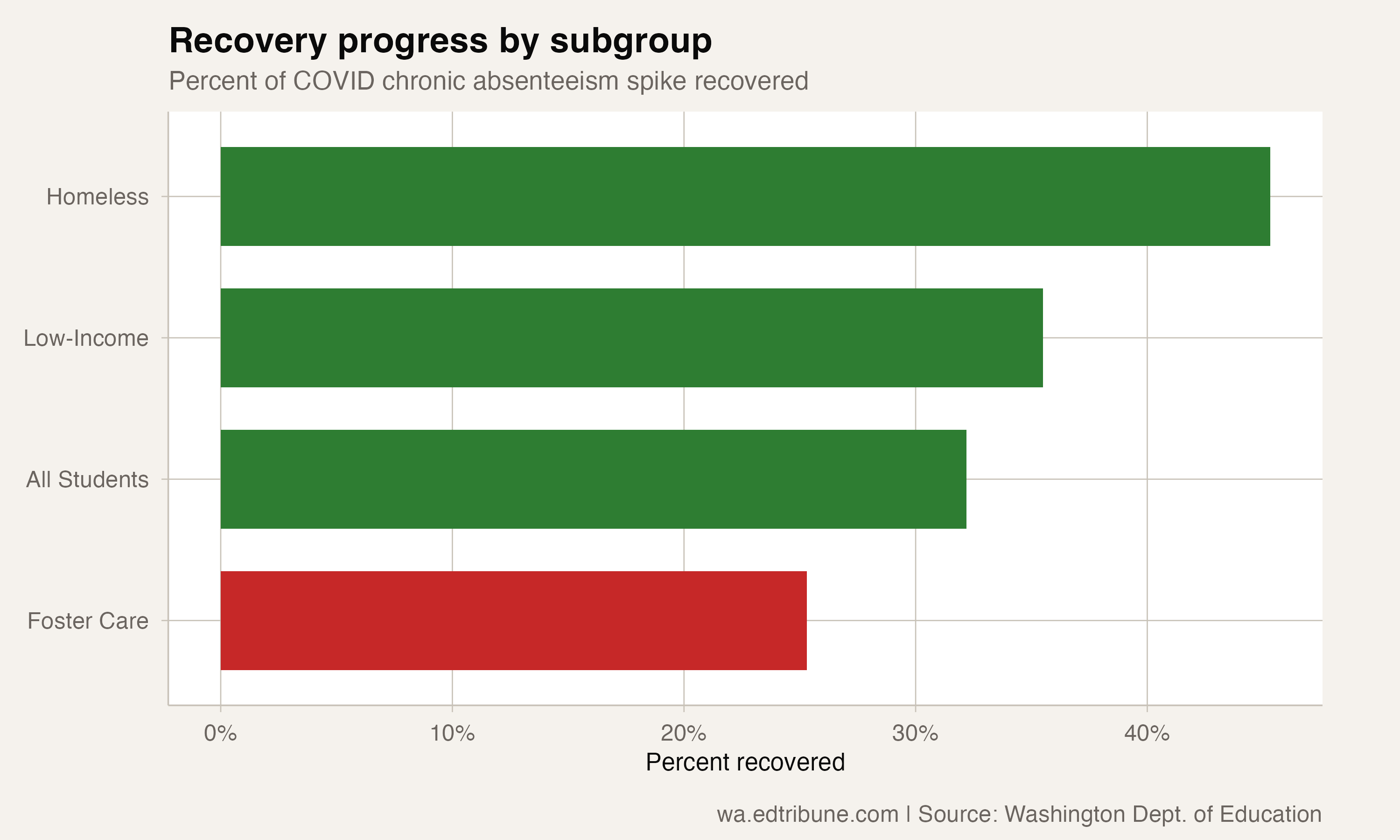
The pre-pandemic rate for foster care was 27.2%. Even that was high, with more than one in four chronically absent before COVID. The 2024-25 rate of 41.6% is still 14.4 points above that level, and the recovery has stalled with most of the pandemic increase in place. Foster care students have recovered just 21.7% of their COVID spike, the lowest of the five vulnerable groups compared here. (Across all student groups, Asian and Pacific Islander students have recovered less.)
The shrinking population paradox
The 49% decline in Washington's foster care student population since 2019, from 7,461 to 3,788, could theoretically have improved the chronic rate if the students leaving the system were disproportionately chronically absent. Instead, the rate held at or above 40%, suggesting that the students who exited foster care were no more or less likely to be chronically absent than those who remained.
Alternatively, the students remaining in foster care in 2025 may represent the most difficult cases: longer placement histories, more complex needs, deeper involvement in the child welfare system. The population shrank, but the challenge per student stayed the same or intensified.
Either way, Washington had 1,575 foster care students who were chronically absent in 2024-25, and their rate has not improved in two years. Without interventions designed specifically for the unique barriers foster youth face, integrated with the child welfare system that creates those barriers, a rate above 40% is likely to persist.
Data from the Washington Office of Superintendent of Public Instruction. Foster care status is reported by school districts based on information from the Department of Children, Youth, and Families. Analysis covers 2014-15 through 2024-25.
Detailed code that reproduces the analysis and figures in this article is available exclusively to EdTribune subscribers.
Discussion
Sign in to join the discussion.
Loading comments...