Correction (October 11, 2026): Washington's Office of Superintendent of Public Instruction republished its attendance files on September 30, 2026, with recalculated counts, and this article now uses the restated figures. An earlier version said the gap between high school and elementary chronic absenteeism in 2024-25, then 11.8 points, was the widest in the data. The gap is 11.6 points in the restated data, the widest since the pandemic, but the 2018-19 gap of 12.1 points was wider. The earlier version also put the grade 12 peak at 38.2% in 2021-22; the restated peak is 38.4%, in 2022-23. And elementary schools have recovered about 44% of their pandemic losses, which we had described as nearly half.
Washington's attendance recovery has a grade problem. In elementary schools, chronic absenteeism has dropped from its pandemic peak of 32.0% to 22.6%, recovering 44% of the ground lost since COVID. In high schools, the rate has barely budged: 34.2% in 2024-25, down just 1.4 points from the 35.6% peak.
The divergence is not subtle. It is a 9.4-point recovery in elementary versus a 1.4-point recovery in high school. And it follows a nearly perfect gradient: the younger the grade, the more the recovery.
The gradient
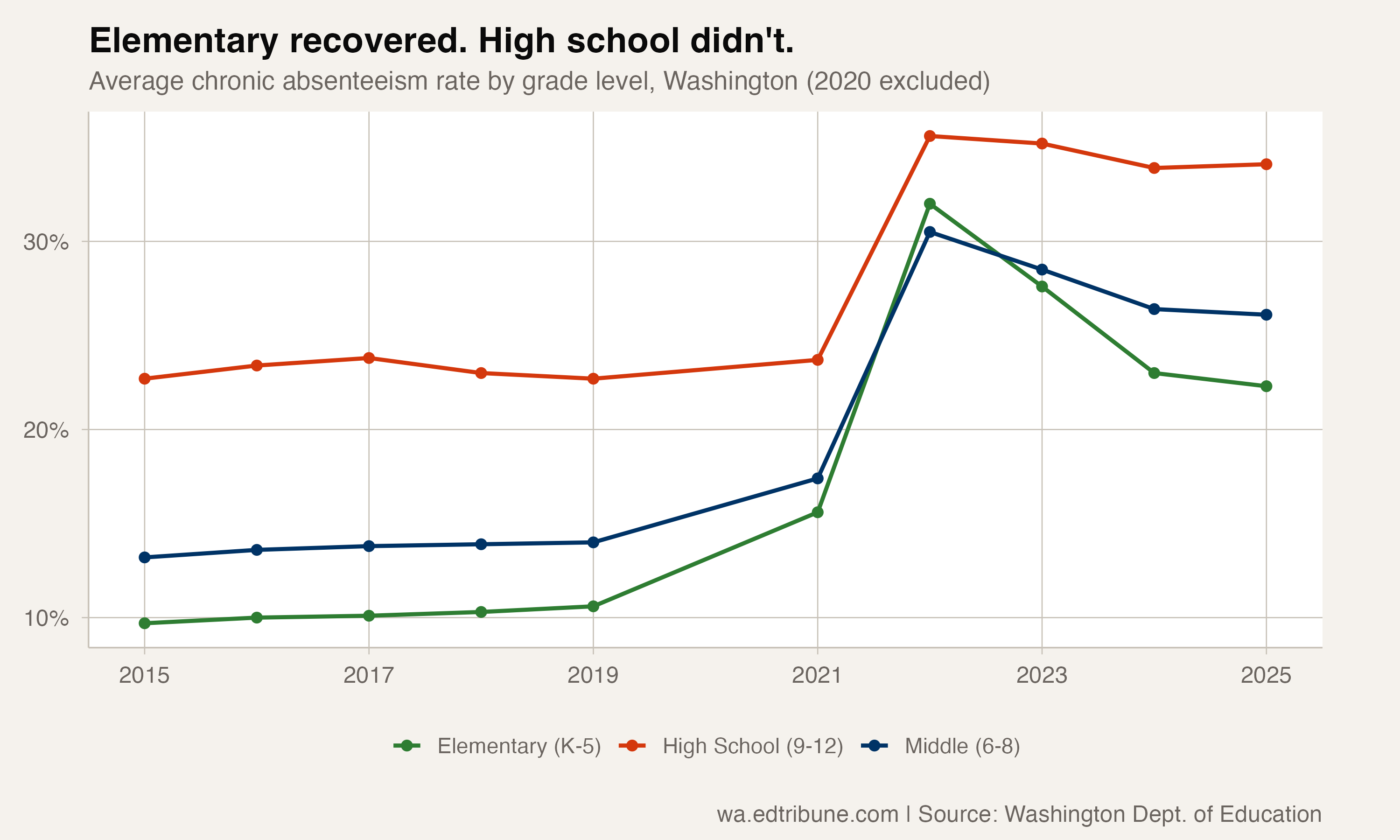
Before the pandemic, high school chronic absenteeism was already substantially higher than elementary: 22.6% versus 10.5% in 2018-19. COVID compressed the gap, pushing both levels into the low 30s. But the recovery has reopened it dramatically. Elementary is now 11.6 points below high school, the widest gap since the pandemic and close to the 12.1-point gap of 2018-19.
Grade by grade, the pattern is monotonic. Kindergarten recovered 12.4 percentage points from its peak. First grade: 11.0 points. The improvement shrinks steadily through the middle grades, until grade 12, where the chronic rate of 37.6% has improved just 0.8 points from its 38.4% peak in 2022-23.
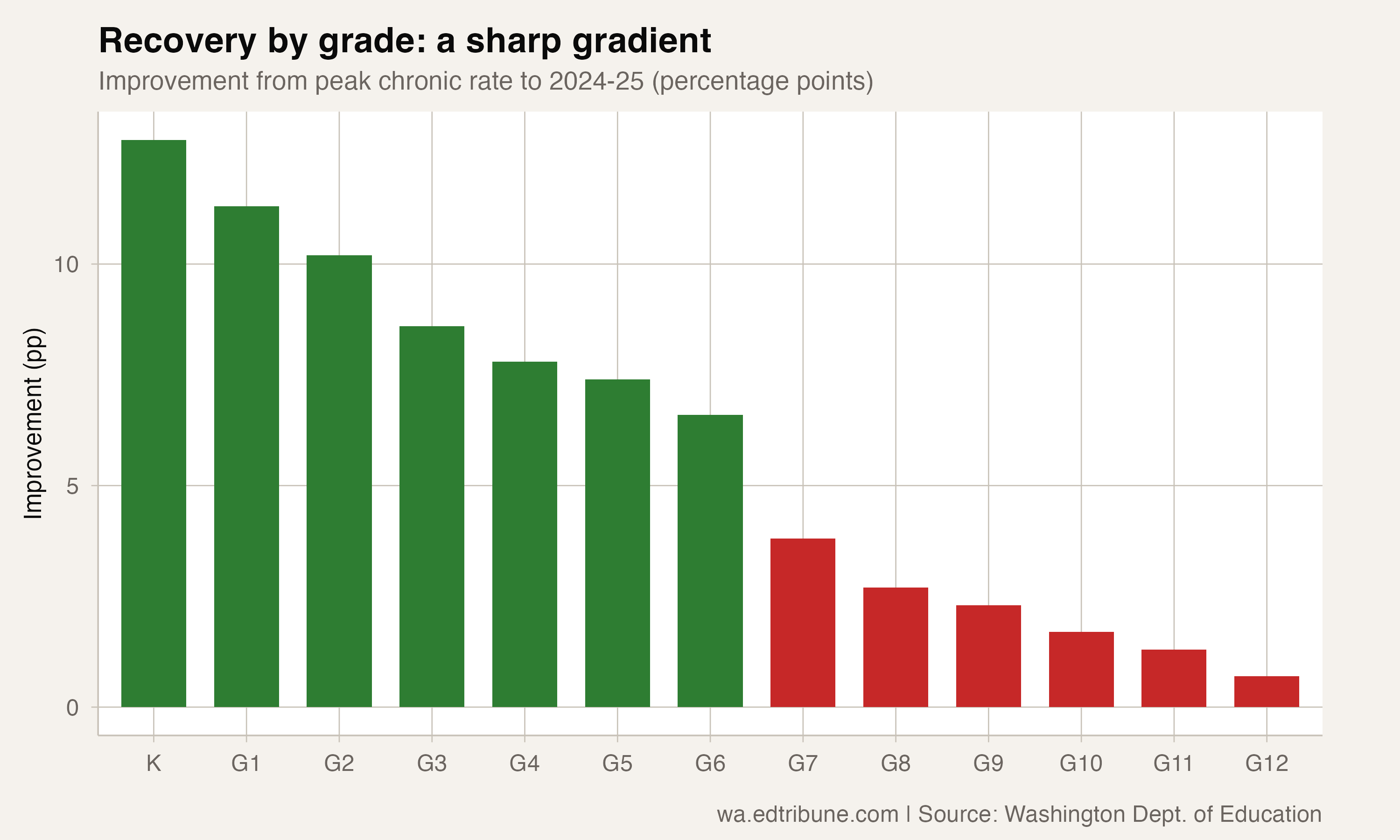
Put differently: kindergarten has recovered 48% of the way back to pre-pandemic. Grade 12 has recovered 8%.
What is different about high school
The gradient is not unique to Washington (it appears nationally), but the severity is striking. Three explanations, none mutually exclusive, account for most of the pattern.
First, older students have more agency over their own attendance. A kindergartner's attendance is largely determined by their parents. A teenager can decide not to go to school, and many are making that decision. The COVID era, which normalized remote and hybrid attendance, may have permanently altered the attendance norms of a generation of teenagers.
Second, older students are more likely to work. The pandemic-era labor shortage pulled high school students into the workforce at higher rates, and many have stayed. A student holding down a part-time job faces structural scheduling conflicts that make regular attendance difficult.
Third, the academic consequences of chronic absenteeism compound with age. A chronically absent first-grader returns to a classroom that is still working on foundational skills. A chronically absent 11th-grader returns to content-specific courses where missed instruction is harder to make up. The gap creates a discouragement spiral: the more school you miss, the harder it is to catch up, the less reason you see to attend.
37.6% of seniors
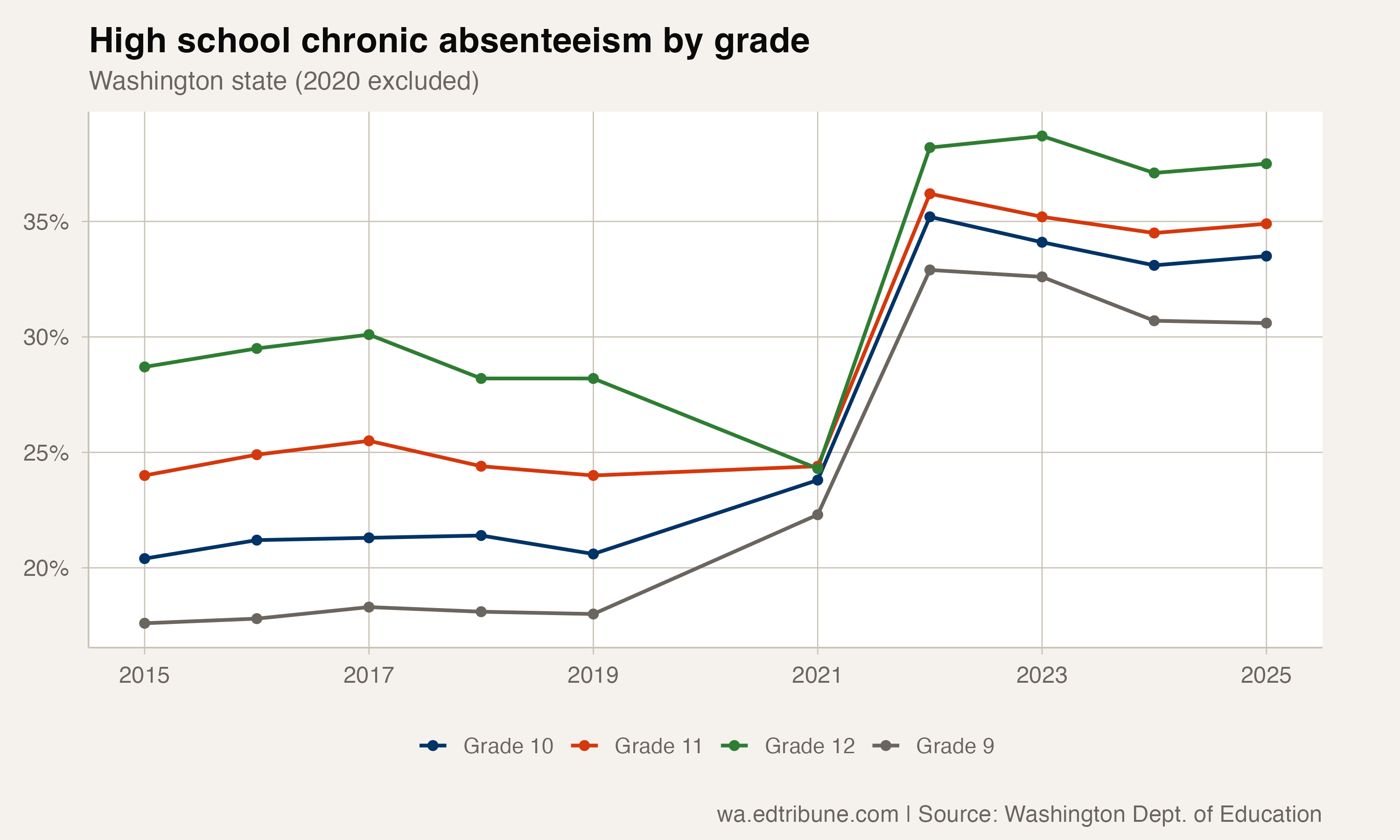
The senior year numbers are especially alarming. In 2024-25, 37.6% of Washington's 96,149 twelfth-graders were chronically absent, roughly 36,000 students in their final year of high school missing a month or more of instruction. The rate has been essentially unchanged for three years: 38.2% in 2022, 38.4% in 2023, 37.3% in 2024, and 37.6% in 2025.
Grade 11 is not much better at 35.0% (91,006 students). Grade 10: 33.6% (88,206 students). Grade 9 is the least-affected high school grade at 30.6% (86,072 students), but even that exceeds the overall state average by 3.3 points.
The stair-step pattern within high school suggests that disengagement accelerates as students approach graduation. Some portion of chronically absent seniors may be credit-sufficient students coasting through a light final-year schedule. Others may be students on the verge of not graduating at all.
SB 5007: the legislative response
The state legislature is paying attention. Senate Bill 5007, a bipartisan measure with $20.4 million per biennium in funding, targets chronic absenteeism specifically in high schools. The bill would create school-based absenteeism intervention teams: counselors, case managers, and community liaisons embedded in high schools to identify at-risk students and address barriers to attendance.
The bill also funds improved data systems for real-time attendance tracking and community grants for organizations working on the structural barriers (transportation, housing, childcare for teen parents) that keep high school students from showing up.
Whether that money is sufficient to move a number that affects 361,433 high school students statewide is an open question. Spread across all high schools, it works out to roughly $56 per student over the two years, enough for a part-time intervention coordinator, not enough for systemic change.
The pipeline question
The grade-level gradient has a demographic dimension worth watching. The students who were in 8th grade when COVID hit in 2020, the cohort that experienced the most formative disruption during early adolescence, are now seniors. Their chronic absenteeism rate of 37.6% may represent the peak of the problem for that cohort. Younger cohorts, who experienced COVID disruption at earlier ages, have more years of in-person schooling since. Whether their improved elementary attendance will survive the transition to high school is the open wager in Washington's attendance data.
The early evidence is not encouraging. Middle school chronic rates, at 26.0%, are recovering faster than high school but slower than elementary. The transition from 8th grade (29.3%) to 9th grade (30.6%) shows only a modest jump, but the escalation from 9th to 12th, a 7.0-point increase, suggests that the forces pulling students away from school intensify with each year of high school, regardless of their elementary experience. If the Senate bill passes, its funding and school-based absenteeism teams will face that escalation directly.
Data from the Washington Office of Superintendent of Public Instruction. Grade-level chronic absenteeism rates aggregated from student-level attendance data. Elementary defined as K-5, middle as 6-8, high school as 9-12.
Detailed code that reproduces the analysis and figures in this article is available exclusively to EdTribune subscribers.
Discussion
Sign in to join the discussion.
Loading comments...