Correction (October 11, 2026): Washington's state education agency republished its attendance data on September 30, 2026, with recalculated counts for every year, and the figures in this article now reflect that edition. The pre-pandemic Hispanic-white gap is 5.1 points, not 4.9, and the gap has narrowed since 2021-22 by about half a point a year, not less than half a point, which would bring it back to the pre-pandemic level around 2032, not 2034. Steilacoom is no longer the third-lowest district on a measured basis; Brewster is. Twelve districts, not 11, had Hispanic rates above 40% across schools that account for their students. The article's other figures were restated to the new edition.
Correction (September 30, 2026): An earlier version of this article said the districts with the lowest Hispanic chronic absenteeism rates were Quillayute Valley (5.5%), Goldendale (12.9%) and Omak (17.2%), and drew an urban-rural contrast from them. All three host online schools that enroll students from across the state, and the state reports those schools' attendance as near-perfect without publishing their student counts, so those districts' rates are not measured by their own schools. Across the schools that do publish counts, Hispanic students' rates were 16.8% in Quillayute Valley, 44.8% in Goldendale and 45.8% in Omak. We replaced those examples and removed the urban-rural contrast. The earlier version also said the Hispanic-white gap widened more than any other group's and that Hispanic students had the second-highest rate of any group. The gap between Pacific Islander and white students widened more, by 9.7 points, and Hispanic students have the third-highest rate. It also gave the Native American gap's growth as 3.9 points (it is 3.8) and Tacoma's Hispanic rate as 42.8% (it is 42.7%). The statewide Hispanic-white gap figures were not affected.
Before the pandemic, the attendance gap between Hispanic and white students in Washington was modest and stable. In the 2018-19 school year, 18.5% of Hispanic students were chronically absent compared to 13.4% of white students, a difference of 5.1 percentage points. It was a gap, but a manageable one, the kind that school districts could plausibly address with targeted outreach and bilingual family liaisons.
Five years later, that gap has nearly doubled to 8.9 points. One in three Hispanic students, 33.2% or 96,552 children, was chronically absent in 2024-25. The pandemic did not merely widen the Hispanic-white attendance gap. It shifted the baseline.
How the gap grew
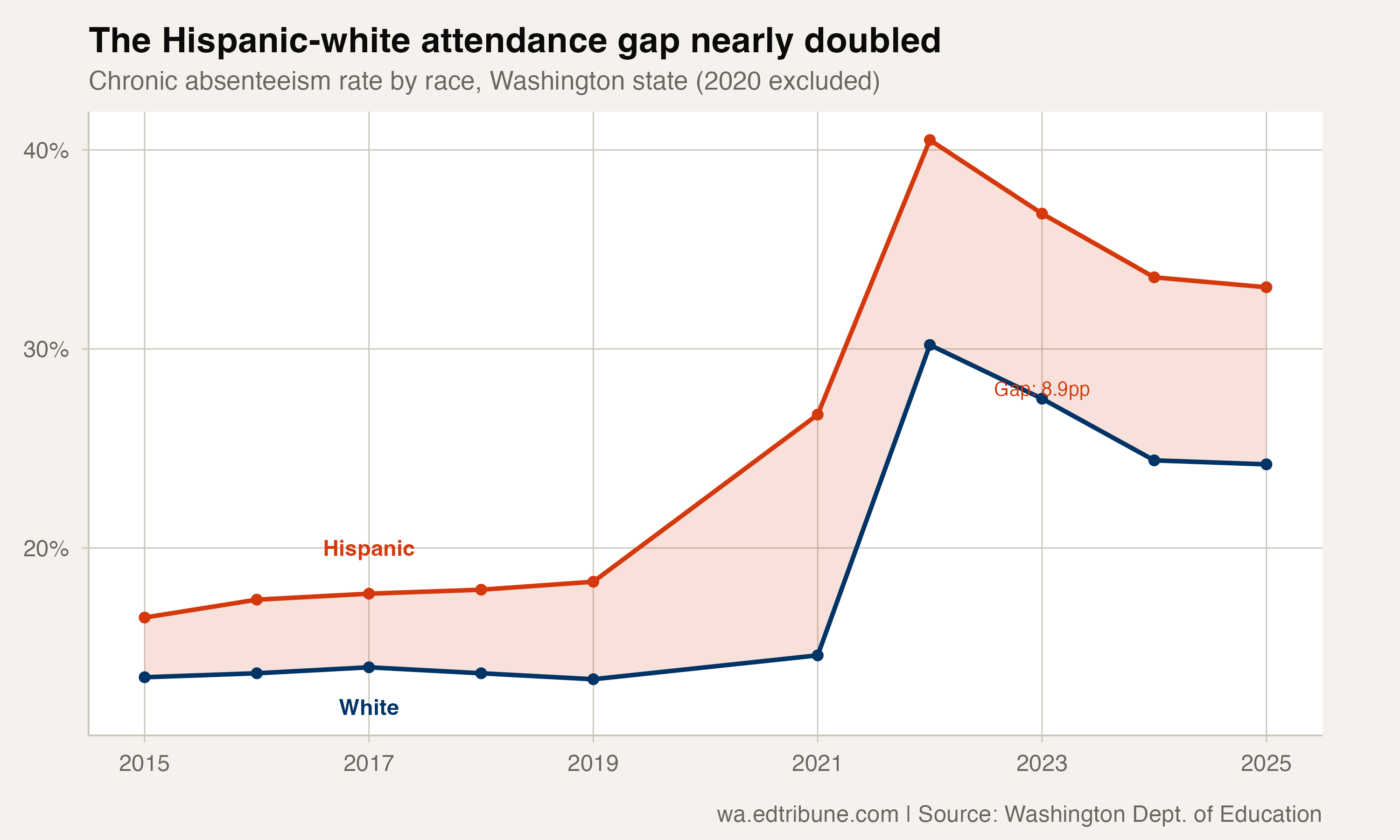
The widening followed a distinctive pattern. In 2020-21, as schools reopened after remote learning, the gap jumped to 12.3 points: Hispanic chronic absenteeism surged to 26.8% while white rates rose to just 14.5%. One possible explanation, which attendance data alone cannot test, is structural: Hispanic families in Washington are disproportionately represented in essential-worker occupations, have higher rates of multigenerational housing, and face language barriers that made navigating return-to-school protocols more difficult.
When overall rates spiked to their peak in 2021-22, the gap actually narrowed to 10.5 points as white chronic absenteeism belatedly caught up. Since then, both groups have improved, but not at the same pace. White students have recovered 5.8 of the 16.7 points they lost (34.7%). Hispanic students have recovered 7.4 of their 22.1-point spike (33.5%). In absolute terms, Hispanic students improved more. In relative terms, they fell further behind.
How the Hispanic gap compares with other groups
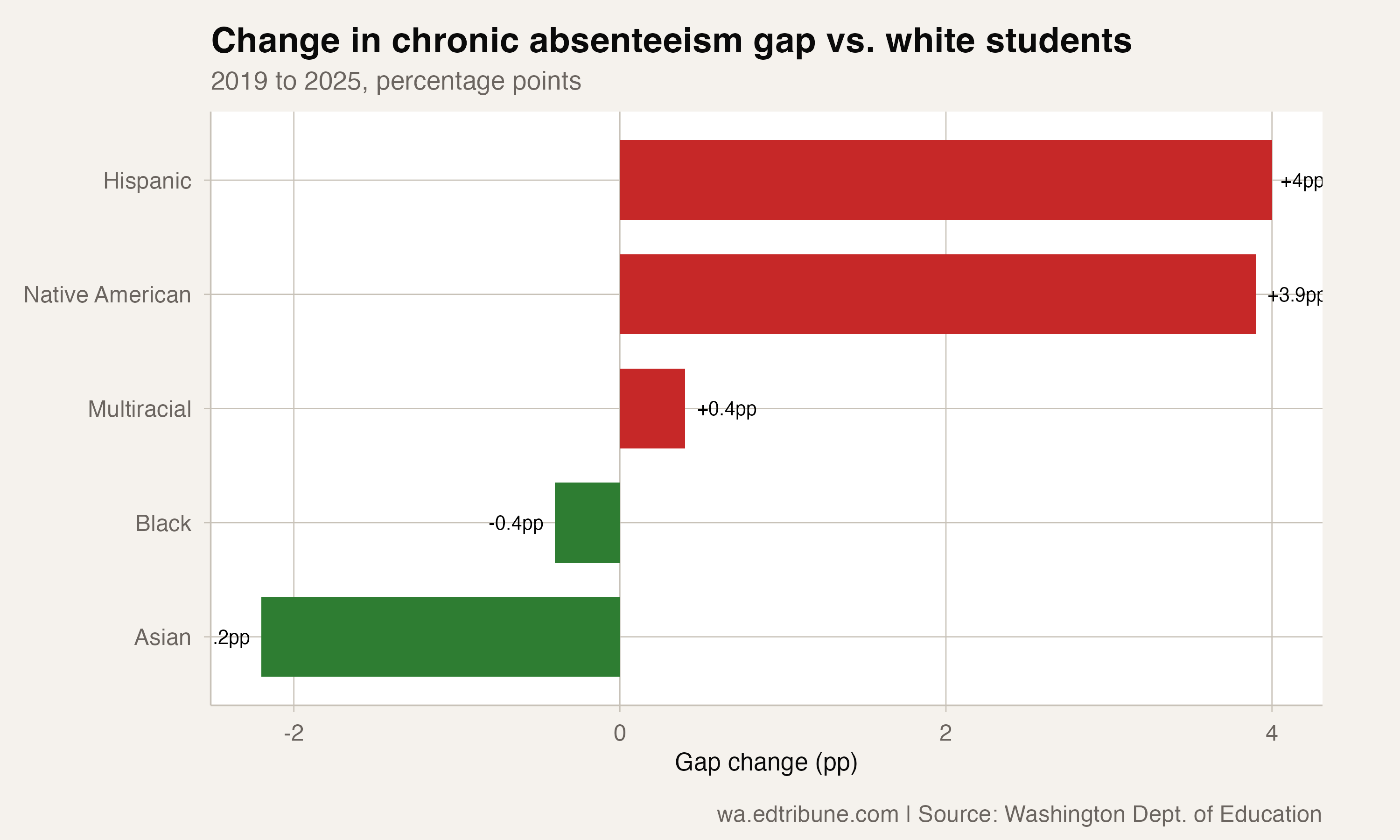
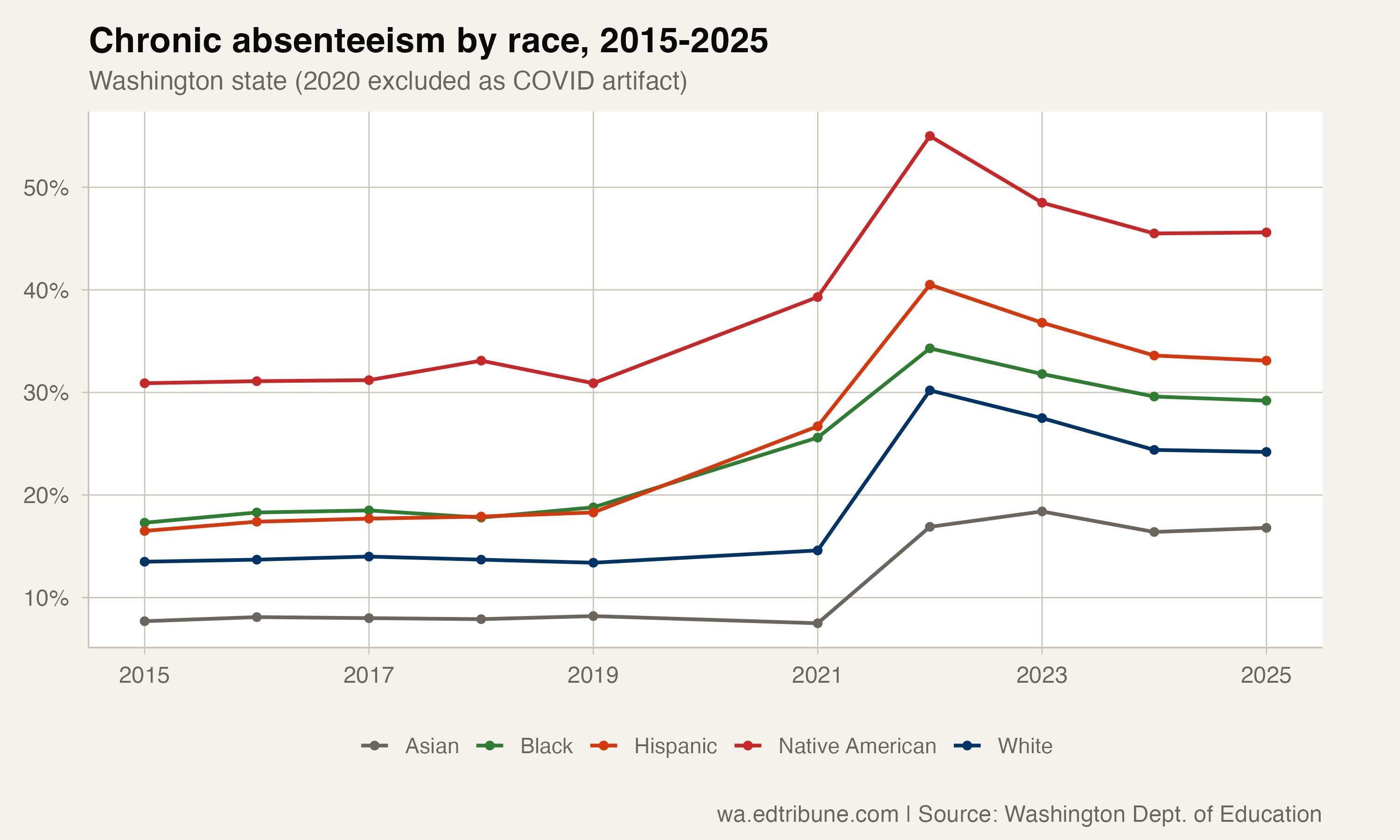
The Hispanic-white gap widened by 3.8 percentage points between 2019 and 2025. It was not the only gap to grow: the Pacific Islander-white gap grew by 9.9 points and the Native American-white gap by 3.9. By contrast, the Black-white gap narrowed by 0.3 points, and Asian students moved further below the white rate (7.4 points below it, compared with 5.2 points before COVID).
Students of color did not all fall behind equally. What sets the Hispanic gap apart is scale: Hispanic students are by far the largest of the groups whose gaps widened, so the same few points of gap reach many more children.
Where the crisis concentrates
At the district level, Hispanic chronic absenteeism rates above two in five are not rare. Among the 110 districts where 500 or more students are Hispanic, 12 whose own schools account for their students had rates that high. Highline↗ET (7,654 Hispanic students) posts a 43.1% chronic rate. Tacoma↗ET (6,846 Hispanic students) reports 42.8%. Cheney, Lakewood, Bellingham, and Burlington-Edison are also in that group.
At the other end, the lowest rates that districts' own schools can account for are in Cashmere↗ET (14.4% of 526 Hispanic students), Lynden (18.0% of 1,021) and Brewster (21.0% of 878). Some districts report lower rates, including Quillayute Valley↗ET at 5.6% among its 1,153 Hispanic students, but those districts host online schools whose attendance the state reports as near-perfect without publishing their student counts. Across Quillayute Valley's schools that do publish counts, the Hispanic rate was 16.9%.
96,552 students
The human scale matters. In 2024-25, Washington had 291,226 Hispanic students, up from 263,977 before the pandemic. The Hispanic share of total enrollment has grown from 23.7% to 26.7%, meaning the group with the third-highest chronic absenteeism rate of any racial or ethnic group is also growing as a share of the student body.
If the Hispanic chronic rate had stayed at its pre-COVID level of 18.5%, roughly 43,000 fewer Hispanic students would have been chronically absent in 2024-25. Instead, 96,552 were, a number well below the 111,700 peak in 2021-22 but still roughly double the pre-pandemic level despite three years of statewide recovery.
The gap is not closing
The trajectory since 2022 is discouraging. The Hispanic-white gap went from 10.5 points in 2022 to 9.6 in 2023, 9.2 in 2024, and 8.9 in 2025. That is narrowing, but at a pace of about half a point per year. At this rate, Washington would not return to the pre-pandemic gap of 5.1 points until about 2032.
Washington's attendance recovery strategies have been largely universal in design, targeted at all students, not at the communities where the crisis is most acute. The gap-narrowing pace of about half a point per year is an answer of sorts: universal approaches are not closing a disparity this large. At 96,552 students, this is no longer a gap. It is a parallel attendance system, split along lines of language and income.
Data from the Washington Office of Superintendent of Public Instruction. Analysis covers 2014-15 through 2024-25. The 2019-20 school year is excluded due to COVID-related attendance tracking anomalies.
Detailed code that reproduces the analysis and figures in this article is available exclusively to EdTribune subscribers.
Discussion
Sign in to join the discussion.
Loading comments...