Correction (October 11, 2026): Washington's state education agency republished its attendance data on September 30, 2026, with recalculated counts for every year, and the figures in this article now reflect that edition. The count of chronically absent students fell by 670 from 2023-24 to 2024-25, not 2,824, to 298,029 rather than 296,544, so at that pace the state would need 194 years, not 45, to return to its pre-pandemic level. The headline figure changed from 297,000 to 298,000, the statewide rate moved from 27.1% to 27.3%, and the article's other counts were restated to the new edition.
Correction (September 30, 2026): An earlier version of this article said the state's 10 largest districts accounted for roughly 98,000 chronically absent students, about one-third of the total, all in the Puget Sound corridor and the Spokane area. They accounted for 78,628, about a quarter, and two of the 10 are in Clark County in southwest Washington. It said 18 districts had more than half of their students chronically absent; the state's current published data shows 19, and two more cross that line across the schools that publish attendance counts. It cited a 2015 count of 155,544 that we cannot verify against the state's current published data, which begins with 2015-16; we now use the 2015-16 figure. We also removed a comparison to the population of the state's fourth-largest city, which was wrong, and replaced a graduation-rate figure whose cited source we could not find with a finding from the same research group.
Percentages can hide scale. When the state reports that 27.3% of students are chronically absent, the number sounds clinical, manageable, abstract. So translate it: 298,029 children missed 18 or more days of school in Washington during the 2024-25 school year.
That is more people than the U.S. Census Bureau counted in Tacoma. And it is 129,684 more students than the 168,345 who were chronically absent in 2018-19, the last school year before the pandemic.
The numbers keep accumulating
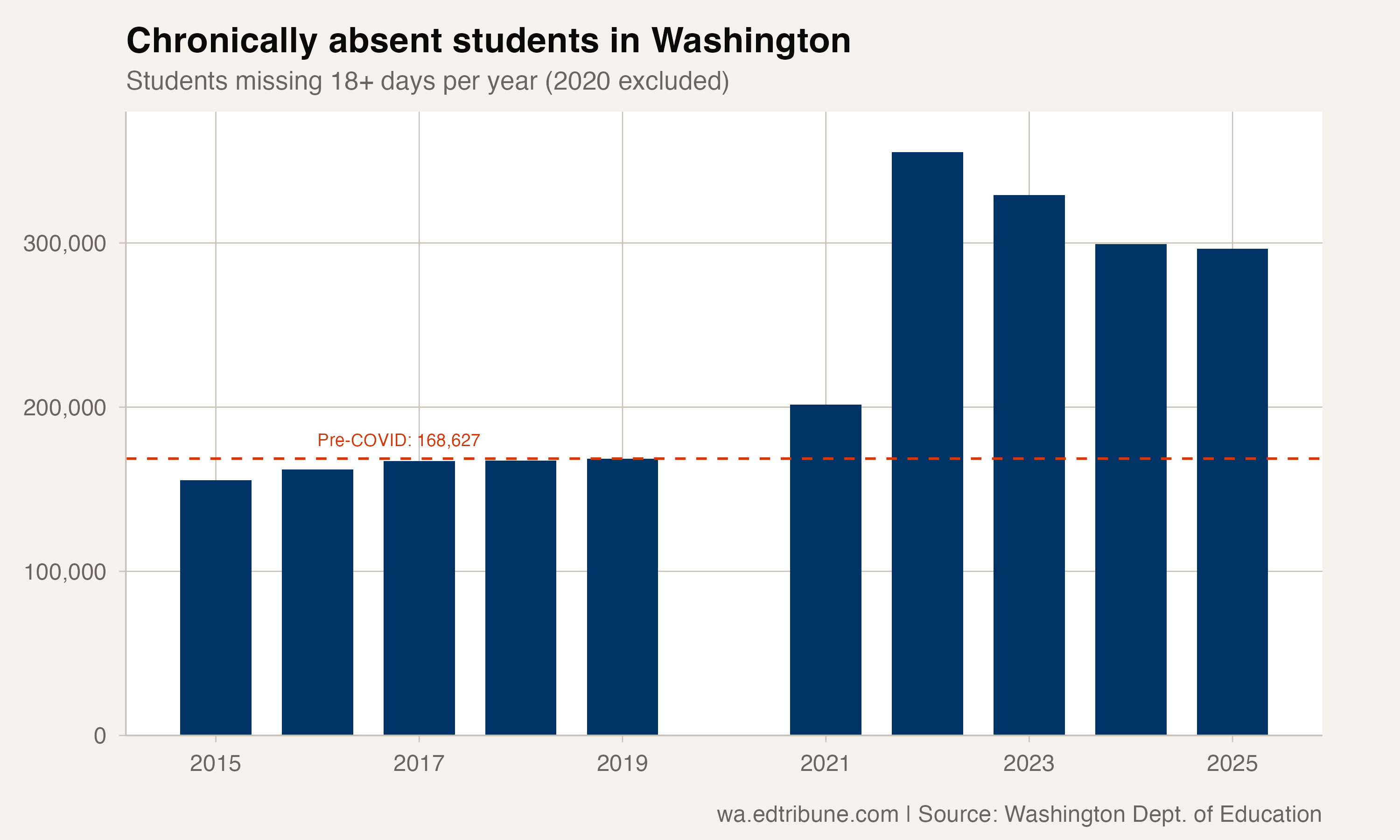
Before COVID, chronic absenteeism was a problem affecting between about 162,000 and 168,000 students a year: significant, but relatively stable. The count rose only modestly, from 161,501 in 2015-16 to 168,345 in 2018-19, as enrollment grew.
The pandemic shattered that equilibrium. In 2021-22, at the crisis peak, 354,664 students were chronically absent, more than double the pre-pandemic level. The count has declined since then, dropping to 328,185, then 298,699, and then 298,029 in 2024-25. But the descent has all but stopped: only 670 fewer students in 2025 than in 2024.
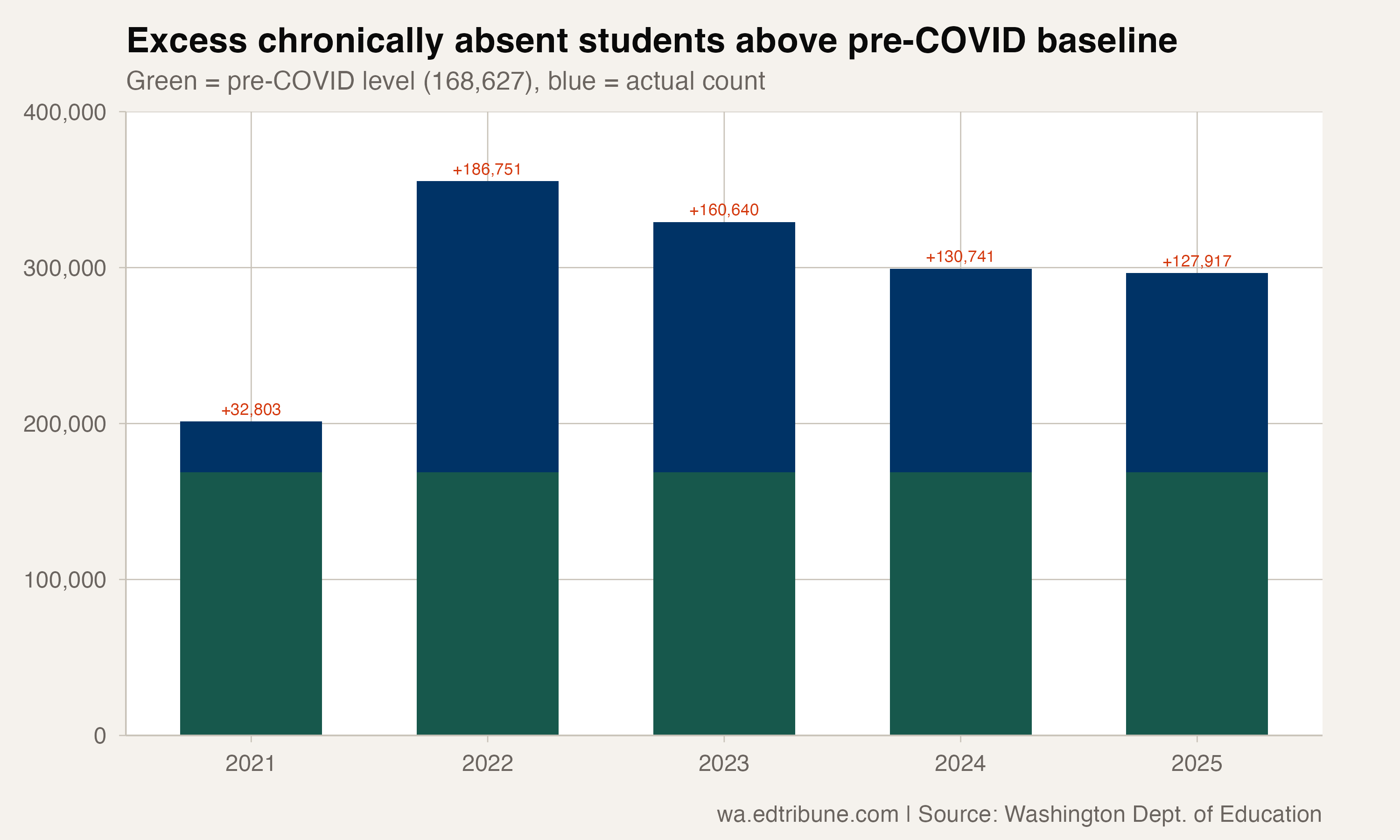
Washington still has 129,684 more chronically absent students than it did in 2018-19. Despite three years of recovery, the state has clawed back only 56,635 of the 186,319 excess students at peak.
1.48 million student-years of disrupted education
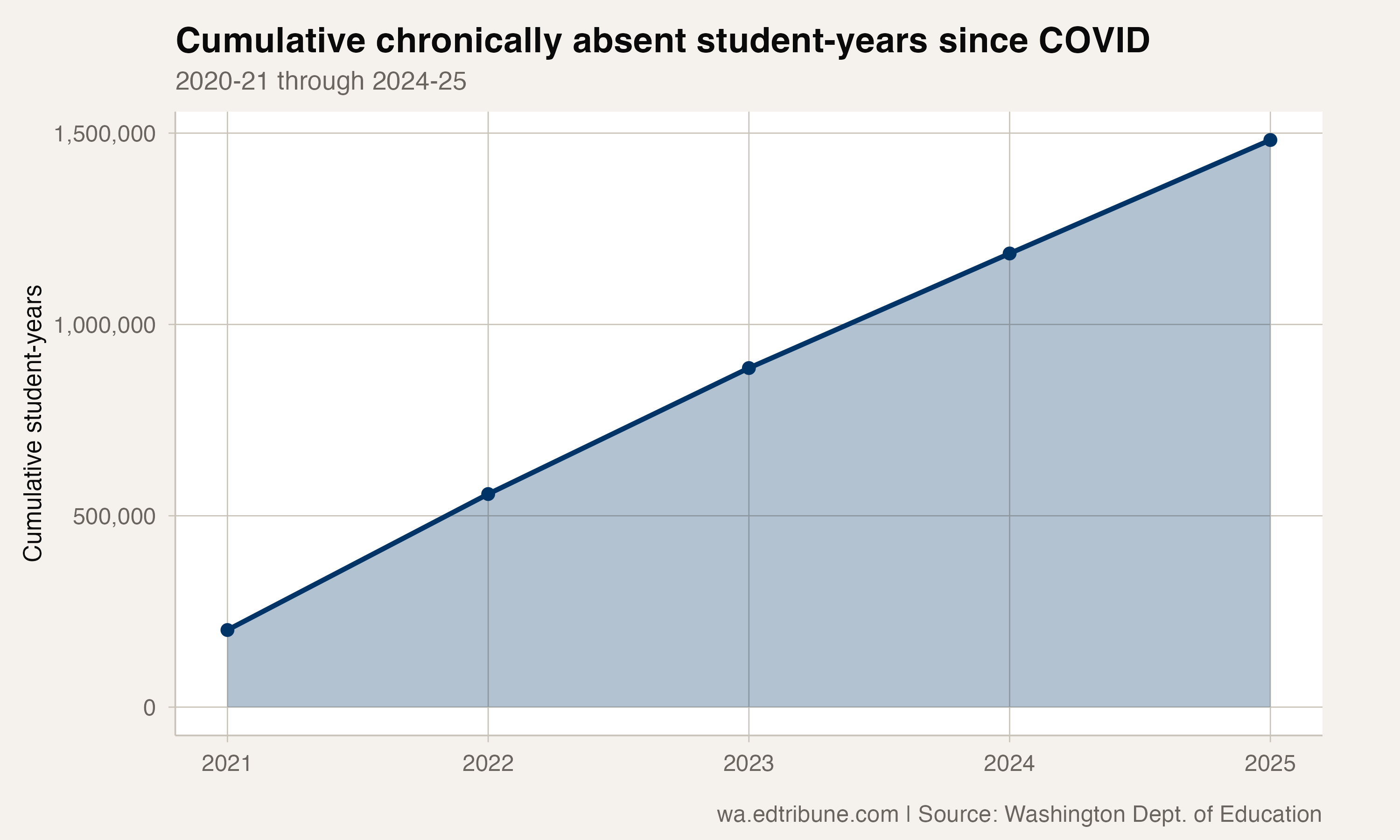
The cumulative toll is staggering. Since 2020-21, Washington has accumulated 1,480,558 student-years of chronic absence. That is 1.48 million individual instances of a student missing a month or more of school in a single year.
The excess above pre-COVID levels, the count of chronically absent students beyond the 2018-19 level, totals 638,833 student-years over five years. These represent the direct educational cost of the attendance crisis: more than 600,000 instances where a student who would have attended regularly before the pandemic did not.
Attendance Works, a nonprofit initiative that works with schools, districts and states on chronic absence, answered The WAEdTribune's questions in writing. Asked whether counting the toll this way changes how policymakers should see the problem, Catherine Cooney, the organization's director of communications, wrote in its answers: "This kind of cumulative framing can be effective in shifting how policymakers understand the urgency and scale of the problem, making visible the total loss of instructional time and student engagement over multiple years, not just a single-year snapshot." Yearly rates still matter, too. "Annual rates remain essential for monitoring improvement and holding systems accountable year over year. Together, they provide a more complete picture that supports both urgency and sustained action," Cooney added.
These are not abstract losses. Research from the University of Chicago Consortium on School Research found that freshman course attendance was eight times more predictive of freshman course failure than eighth-grade test scores, and that how students fare in their freshman courses strongly predicts whether they graduate. Across 1.48 million student-years, the downstream effects on graduation rates, college enrollment, and workforce readiness will compound for a decade.
Where 298,029 students live
The chronically absent population is not evenly distributed. The state's 10 largest districts account for 78,333 of the 298,029, about a quarter of the total (26.3%). Seven of them are in the Puget Sound region; the others are Spokane and two Clark County districts, Vancouver and Evergreen.
The highest rates, though, are concentrated in small districts. Of the 45 districts where more than 40% of students were chronically absent in 2024-25, 42 enrolled fewer than 1,000 students, and none of the 32 districts with 10,000 or more students was above 40%. In 19 districts, more than half of all students were chronically absent, going by the rates the state publishes for each district. Two more, Wellpinit and Republic, cross that line across the schools that publish attendance counts: Wellpinit's published rate is 49.2% but 65.9% across those schools, and Republic's is 31.7% against 52.3%, because each includes a program whose attendance the state does not publish school by school. In these places, regular attendance is the exception.
The per-student framing matters for policy. Washington funds schools based on enrollment, not attendance, which means the financial impact of chronic absenteeism falls on outcomes rather than budgets. A district does not lose money when a student misses school. But it loses the student's education, and the compounding returns of consistent instruction are the entire reason the system exists.
The question of trajectory
At the latest pace of improvement, roughly 700 fewer chronically absent students per year, Washington would not return to pre-pandemic levels for 194 years, which says less about a timeline than about how close to flat the 2024-25 count was. Even at the much faster 2024 pace (roughly 29,000 fewer per year), it would take four to five years to close the gap.
The most likely scenario falls between these extremes, but the 2025 slowdown raises the possibility that the state is approaching a stable equilibrium well above the pre-pandemic norm. If that is the case, Washington will need to recalibrate not just its attendance interventions but its expectations, either accepting that a quarter of its students missing a month of school per year is the new baseline, or finding interventions capable of reaching the families for whom regular attendance remains out of reach.
Attendance Works sees the same slowdown beyond Washington. "We are beginning to see signs of a plateau nationally in recovery from pandemic-era chronic absence, so Washington is not alone in experiencing this shift," Cooney wrote. "However, this slowdown is uneven across and within states. For example, rates are more likely to be stalled in middle and high schools than in elementary schools."
"State leaders are uniquely positioned to take action to reverse the attendance crisis," Cooney wrote, pointing to guidance, public data, policy and funding as the levers states hold. The organization has published a toolkit for state education agencies built around that work.
Data from the Washington Office of Superintendent of Public Instruction. Chronic absenteeism defined as missing 18+ days per school year. The 2019-20 school year excluded due to COVID-related attendance tracking anomalies.
Detailed code that reproduces the analysis and figures in this article is available exclusively to EdTribune subscribers.
Discussion
Sign in to join the discussion.
Loading comments...