Correction (September 30, 2026): An earlier version of this article said seven tribal school districts in Washington had chronic absenteeism rates above 50%. There are eight: the earlier count left out Quileute Tribal School (55.9%). The earlier version also gave the statewide Native American rate as 45.6% (roughly 5,769 students); in the state's current data it is 45.5% (5,762 students), so the gap with white students is 21.3 points (not 21.4), the recovery from the 2021-22 peak is 9.5 points (not 9.4), and returning to the pre-pandemic rate would take a 14.6-point reduction (not 14.7). It said Native American students' rate dwarfed every other group's, but Pacific Islander students' rate (49.8%) is higher, and it said their recovery had been slower in relative terms, but they have recovered a larger share of their pandemic increase than white students. It gave Marysville's overall rate as 35.5% (it is 36.9%). It cited 2015 enrollment and attendance figures that we could not verify; those comparisons now start in 2015-16. It also cited a national ranking whose source link no longer works, and we removed it. (Update, October 11, 2026: in the edition of the attendance data the state republished on September 30, 2026, the statewide rate is 45.6%, or 5,769 students, and the figures in this article now follow that edition.)
At Muckleshoot Tribal School, southeast of Auburn, 64.4% of the 483 students enrolled in 2024-25 were chronically absent. At the Lummi Nation's schools near Bellingham, the rate was 69.4%. At the Suquamish Tribal Education Department on the Kitsap Peninsula, it was 74.1%, meaning roughly three out of four students missed at least 10% of the school year.
These are not outliers. They are the extreme end of a crisis affecting Native American students across Washington, whose chronic absenteeism rate is the second-highest of any racial group in the state.
45.6%: Nearly one in two
Statewide, 45.6% of Native American students were chronically absent in 2024-25. That is about 1.7 times the overall state rate of 27.3% and 21.3 percentage points above the white student rate of 24.3%. Among Washington's 12,643 Native American students, 5,769 missed at least 10% of their school days. Only Pacific Islander students had a higher rate, at 49.8%.
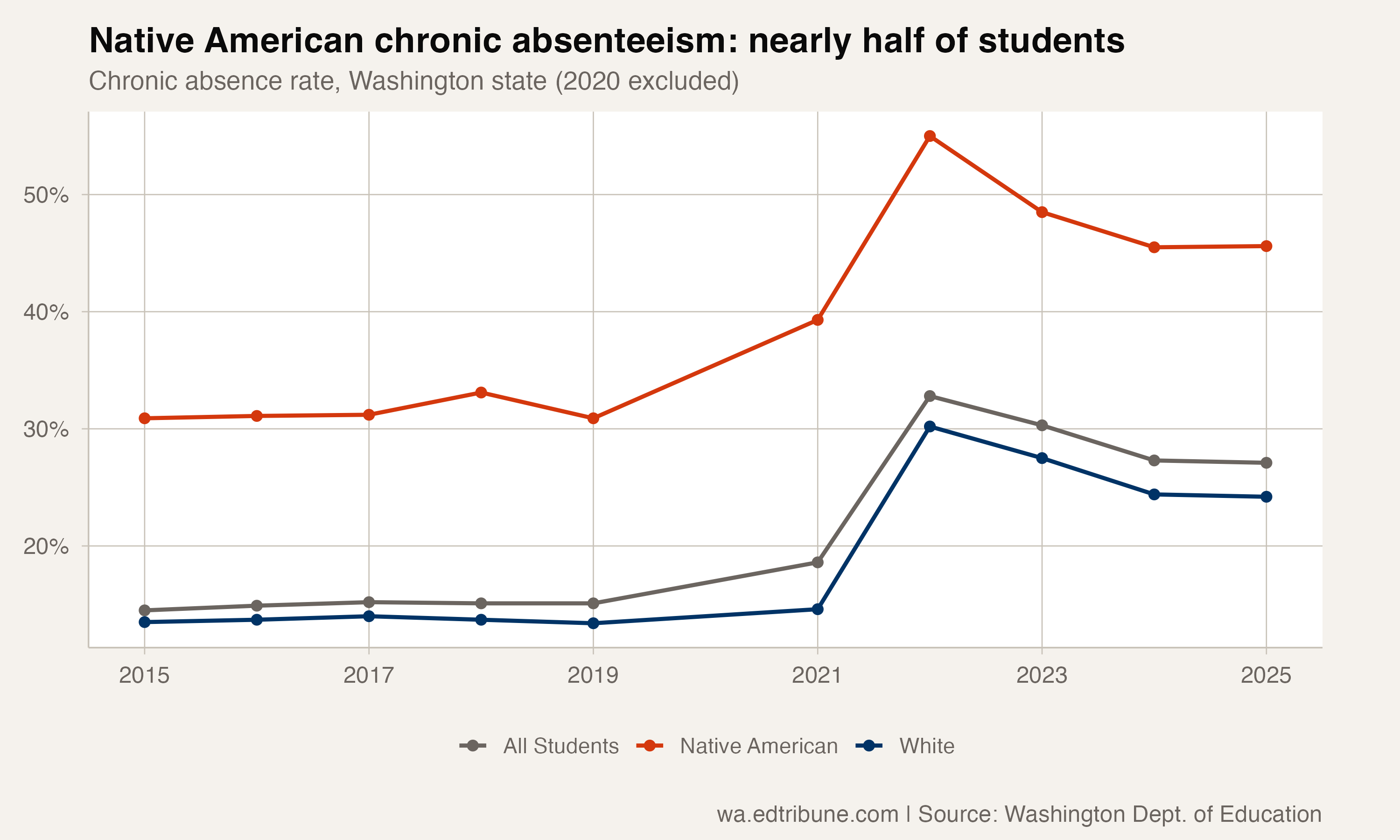
The gap between Native American and white students is wider than it was before the pandemic. In 2018-19, the difference was 17.4 points (30.8% vs. 13.4%). By 2024-25, it had grown to 21.3 points. Native American students recovered 9.3 points from their 54.9% peak in 2021-22, the largest absolute improvement of any racial group, but they started so far above most other groups that the recovery still leaves them closer to majority-absent than to the state average.
The tribal school crisis
Eight Washington districts that are tribal schools or public districts on reservations have chronic absenteeism rates above 50%. In these communities, regular school attendance is the exception.
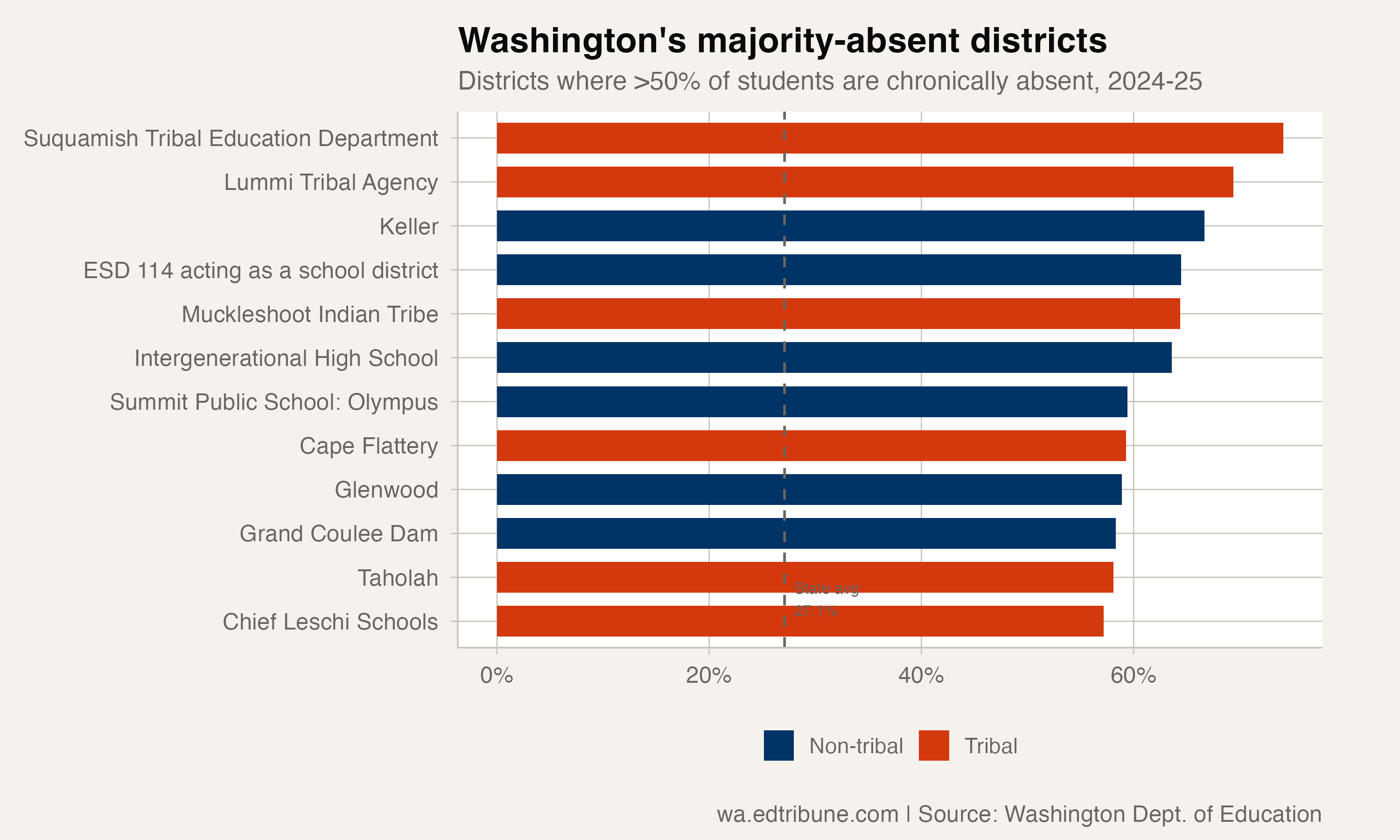
The highest rates cluster along a corridor from the coast to the foothills: Suquamish (74.1%), Lummi (69.4%), Muckleshoot↗ET (64.4%), Cape Flattery↗ET (59.3%), Taholah (58.1%), Chief Leschi↗ET (57.3%), WA HE LUT (56.7%) and Quileute (55.9%). Six of the eight are schools run by tribes. Cape Flattery, which includes Neah Bay on the Makah Reservation, and Taholah, on the Quinault Reservation, are public districts serving reservation communities. All of them serve communities that face compounding challenges: rural isolation, intergenerational poverty, housing instability, and long-standing health disparities.
The published rates can also understate the problem. Wellpinit, the public district on the Spokane Reservation, reports 49.2%. That figure includes students in its Open Doors re-engagement program, which the state reports only as above 97.3% regular attendance, without counts. Across Wellpinit's schools with published counts, the rate was 65.9%.
Non-tribal districts where Native American students are concentrated show the crisis too. At Marysville↗ET School District, which borders the Tulalip Reservation, 71.5% of the district's 505 Native American students are chronically absent, while the district's overall rate is 36.9%. La Conner, near the Swinomish Reservation, reports 60.8% for its 166 Native American students.
A gap the pandemic widened but did not create
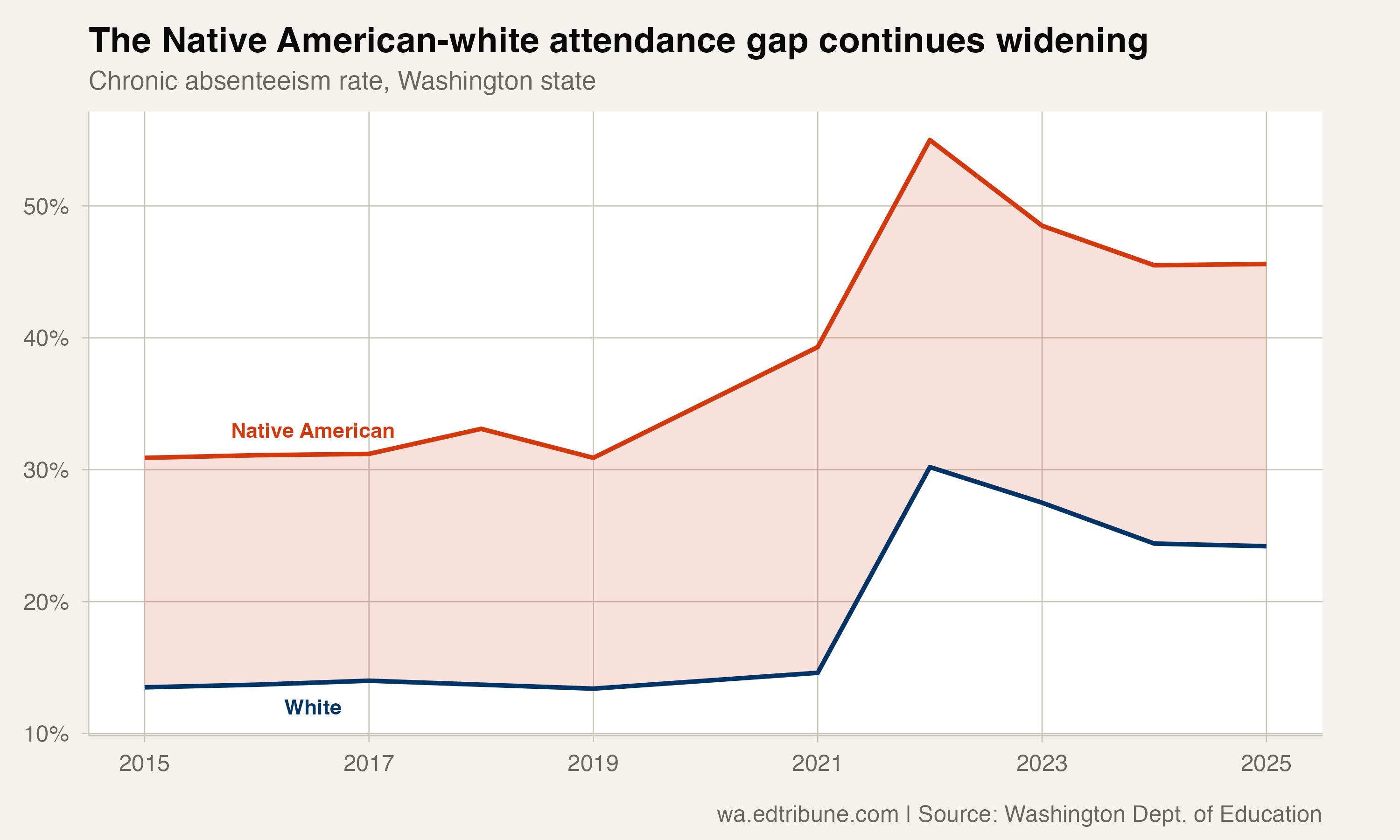
The pre-pandemic gap was already severe. In 2018-19, when the state's overall chronic rate was 15.1%, Native American students were already at 30.8%. The pandemic spiked their rate to 54.9%, a 24.1-point increase, compared to a 16.7-point increase for white students. Native American students have since recovered 39% of that increase, slightly more than white students (35%), but they remain 14.8 points above their pre-pandemic rate, against 10.9 points for white students.
The structural barriers to attendance in tribal communities are distinct from those in urban or suburban districts. Transportation on reservations can mean long distances on poorly maintained roads. Housing instability on tribal land operates differently from urban homelessness, with overcrowded multigenerational homes rather than shelters. Health access is often limited to Indian Health Service facilities that may be hours away. And the historical relationship between Native families and formal schooling carries a weight that attendance-nudge interventions were not designed to address.
The shrinking denominator
Washington's Native American student population declined 15.8% over nine years, from 15,013 in 2015-16 to 12,643 in 2024-25. The combination of declining enrollment and rising absenteeism means that the number of Native American students consistently attending school is shrinking faster than the enrollment numbers alone suggest.
With 5,769 of 12,643 students chronically absent in 2024-25, 6,874 attended regularly. In 2015-16, with a 30.8% chronic rate and 15,013 students, 10,382 attended regularly. That is a 34% decline in the number of regularly attending Native American students, a collapse in consistent school participation that compounds every other educational challenge these communities face.
What recovery would require
Bringing Native American chronic absenteeism back to its 2018-19 level (30.8%) would require a 14.8-point reduction from the 2024-25 rate. The rate did not move between 2023-24 and 2024-25, holding at 45.6%. If it fell at its average pace since 2022-23 (48.3%), about 1.4 points a year, getting back to the 2018-19 level would take roughly 11 more years. That is a projection from the recent pace, not a forecast. Closing the gap with white students entirely would require an additional 6.5 points beyond that.
The scale of the problem suggests that school-level interventions alone will not be sufficient. The districts with the highest Native American chronic rates are the same ones dealing with underfunded tribal infrastructure, limited healthcare access, and housing conditions that make regular attendance physically difficult. Solving the attendance crisis in tribal communities will require addressing the conditions that cause absence, not just tracking who is absent.
Data from the Washington Office of Superintendent of Public Instruction. Analysis covers 2015-16 through 2024-25. The 2019-20 school year is excluded because pandemic school closures cut that attendance year short. Tribal schools and reservation districts are identified by name; Washington does not have a formal tribal school flag in its data system.
Detailed code that reproduces the analysis and figures in this article is available exclusively to EdTribune subscribers.
Discussion
Sign in to join the discussion.
Loading comments...