Correction (October 11, 2026): Washington's state education agency republished its attendance data on September 30, 2026, with recalculated counts for every year, and the figures in this article now reflect that edition. The 2021-22 peak was 43 districts, not 41, and the headline now says so. Before the pandemic, three to six districts a year were on the list, not two to four. Of the 43 districts on the 2021-22 list, 27 had dropped below half by 2024-25 (not 26) and 14 were still above it (not 13); five, not six, have joined since. The 2024-25 count of 19 did not change.
Correction (September 30, 2026): An earlier version of this article was built on an older copy of the state's attendance data. The state's current published data shows 19 districts, not 18, where more than half of students were chronically absent in 2024-25, enrolling 4,167 students (not 4,046), of whom 2,540 were chronically absent (not about 2,434). Why Not You Academy, at 87.6%, now has the highest rate, and ESD 114, Keller, Intergenerational High School, Summit Public School: Olympus, Glenwood, Lyle, St. John, Index and Rooted School Washington are on the list. The count for 2023-24 is 24, not 22, and 26 districts sit between 40% and 50%, not 21. We removed a comparison calling the 2025 count six times the pre-pandemic norm. We also added a note on two districts, Wellpinit and Republic, where more than half of students were chronically absent across the schools that publish attendance counts even though their district rates are below 50%.
In most school districts, chronic absenteeism affects a minority of students. In 19 Washington districts in 2024-25, it was the norm: more than half of all students missed 18 or more days of school. Regular attendance, showing up consistently week after week, was the unusual thing.
The list runs from Why Not You Academy, where 87.6% of 121 students were chronically absent, to Rooted School Washington, where the rate was 50.9% among 55 students. In between are tribal schools, remote rural districts, small schools and programs that the state reports as their own districts, and one district that stands apart for its size.
Who they are
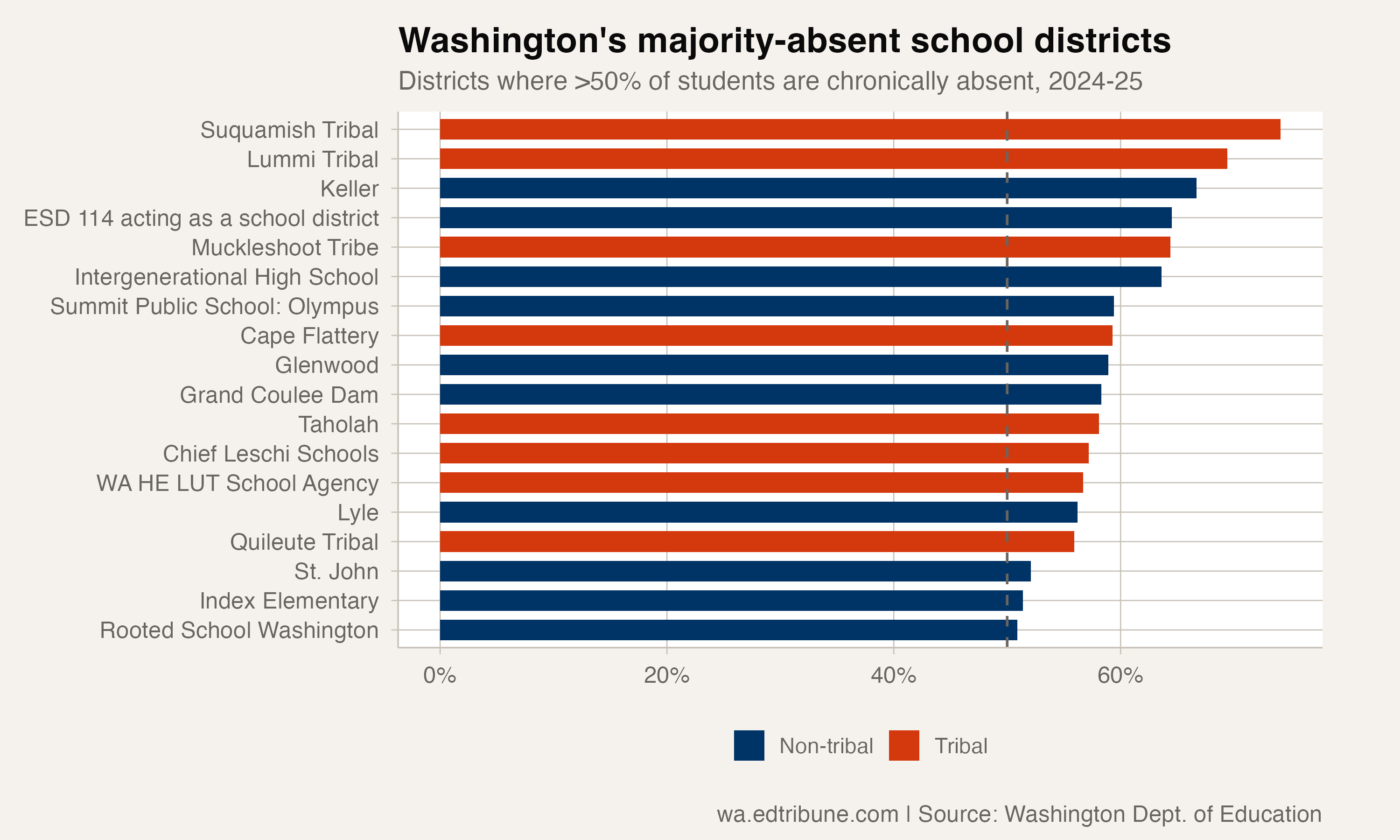
Eight of the 19 are tribal school entities: Suquamish (74.1%), Lummi↗ET (69.4%), Muckleshoot↗ET (64.4%), Cape Flattery↗ET (59.3%), Taholah (58.1%), Chief Leschi↗ET (57.3%), WA HE LUT (56.7%) and Quileute (55.9%). The other 11 are a mix of tiny rural districts, alternative programs and small schools, plus Grand Coulee Dam School District, with 678 students and a 58.3% chronic rate.
Grand Coulee Dam is the largest district on the list by enrollment. Located in north-central Washington near the Columbia Plateau, it serves a community built around the dam's construction in the 1930s and now home to the Colville Confederated Tribes. The intersection of rural isolation, tribal demographics, and economic stagnation creates a context where regular attendance faces structural barriers that most districts do not encounter.
The list is shrinking, slowly
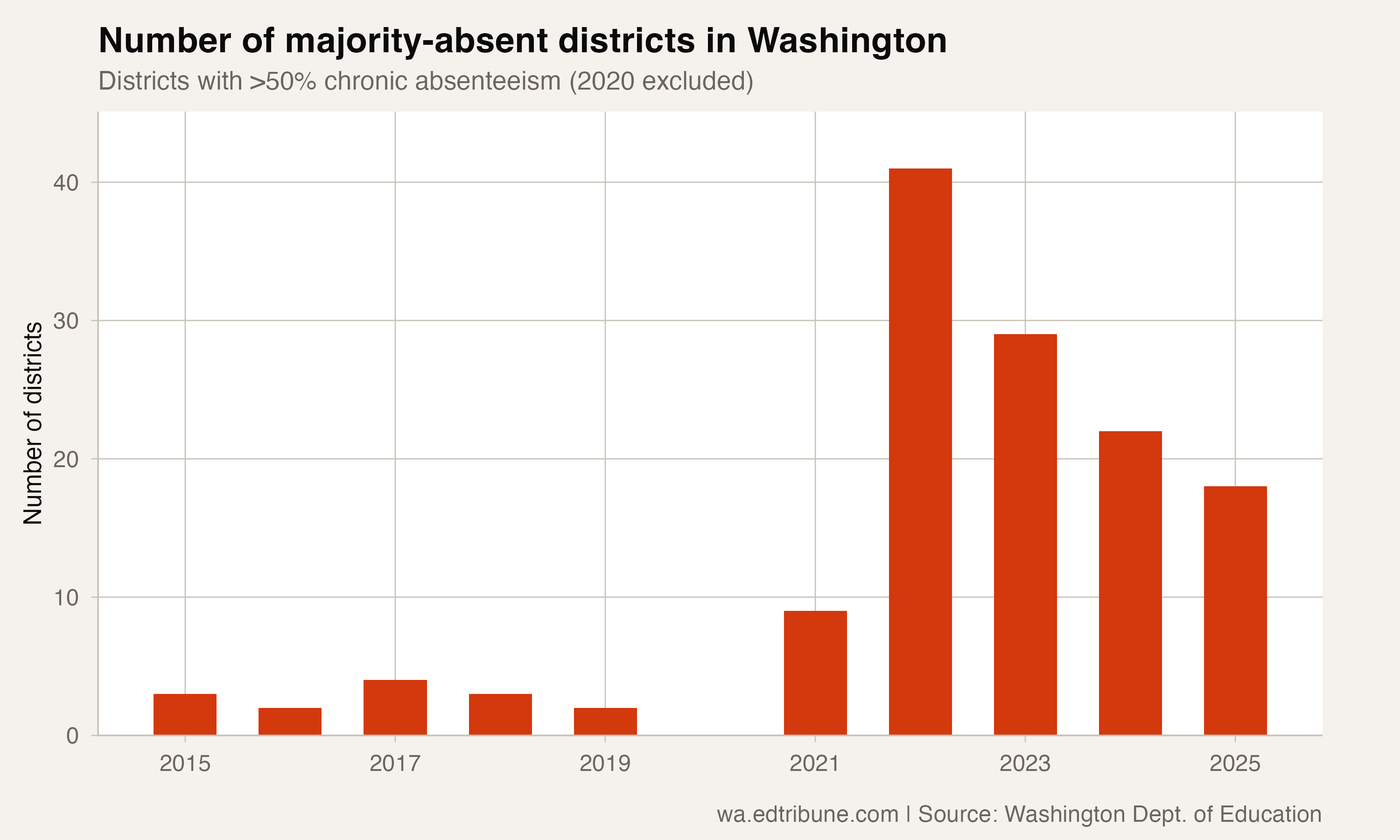
Before the pandemic, between three and six districts a year had at least half of their students chronically absent. In 2020-21 there were 10. In 2021-22 the count surged to 43, more than one in eight of the 317 districts with a published rate that year. It has fallen every year since: to 30 in 2022-23, 24 in 2023-24 and 19 in 2024-25.
That is progress, but the count is still far above where it stood before the pandemic, when three districts crossed the line in 2018-19. The districts that left the list since the peak were a different group from the ones that stayed. All 27 districts that dropped below 50% by 2024-25 were non-tribal, and they tended to be larger. Of the 43 districts on the 2022 list, 14 are still on it, including all seven tribal districts that were on it then. Five districts have joined since.
These counts use the rates the state publishes for each district. Two more districts would join the 2024-25 list if the rate were taken across the schools that publish attendance counts. Wellpinit School District's published rate was 49.2%, but across its schools with published counts it was 65.9%. About 25% of the district's students are outside those schools; the one school without published counts is Wellpinit Open Doors High School, whose attendance the state does not publish school by school. Republic School District's published rate was 31.7%, against 52.3% across its schools with published counts. There, 39% of students are outside those schools, and the one school without published counts is Republic Parent Partner, which the state also does not report school by school. Counted that way, the 2024-25 list would hold 20 districts whose schools publish counts, plus the educational service district program that runs schools in two county juvenile detention centers, which publish no counts, so its district rate is the only figure; the 2021-22 peak would still be 43.
4,169 students
The 19 districts enrolled 4,169 students in 2024-25, a tiny fraction of Washington's 1.09 million. In percentage terms, they educate less than 0.4% of the state's students. The chronic attendance crisis, at its most extreme, is a small-number problem.
But the severity within these districts is extraordinary. Of those 4,169 students, 2,541 were chronically absent. In Suquamish, 60 of 81 students missed a month of school or more. In Lummi, 302 of 435. In Chief Leschi, 382 of 667. These are communities where the school system's fundamental promise (that students will be present to receive instruction) is not being kept for the majority.
The tribal dimension
The concentration of tribal schools on this list reflects challenges that extend well beyond education policy. Tribal communities in Washington face compounding barriers: rural isolation, inadequate housing, limited healthcare access through Indian Health Service, intergenerational trauma from historical boarding school policies, and economic conditions that make stable family routines difficult.
The attendance rates in these communities are not primarily a school problem. They are a reflection of conditions that make regular attendance structurally difficult: stable housing, reliable transportation, adequate health, and a family schedule compatible with the school day.
That does not make the attendance data less alarming. A student who misses 18 days has already lost a tenth of the school year, and many chronically absent students miss far more than that. The educational consequences are severe regardless of their root causes.
Below the threshold
Another 26 districts had chronic rates between 40% and 50% in 2024-25, Wellpinit among them: not majority-absent on their published rates, but close. If the statewide recovery stalls, some of these districts may cross the 50% line. If it accelerates, more of the current 19 may drop below it.
The count is, in a sense, the sharpest indicator of whether Washington's attendance recovery is reaching everyone. When the most-affected districts start returning to pre-pandemic rates, the crisis will genuinely be receding. For now, 19 districts remain in a category that should not exist at all.
Data from the Washington Office of Superintendent of Public Instruction. Analysis includes all district entities with a published rate in each year; counts use the state's published district rates, and 2019-20 is excluded. Tribal school districts identified by name.
Detailed code that reproduces the analysis and figures in this article is available exclusively to EdTribune subscribers.
Discussion
Sign in to join the discussion.
Loading comments...