Correction (September 30, 2026): An earlier version of this article, headlined "Quillayute Valley Keeps 96% of Its Students Who Are Homeless in Class. Statewide, Half Are Chronically Absent.," held up Quillayute Valley (4.0% of its 177 students who are homeless chronically absent) and South Bend (7.0% of 172) as rare exceptions. Neither rate is a reliable measure. Both districts host online schools that enroll students from across the state, and the state reports those schools' attendance as near-perfect without publishing their student counts. None of Quillayute Valley's 177 students who are homeless appears in a school row with published counts, and across South Bend's schools that do publish counts the rate was 25.5%. We replaced that passage with the lowest rates among districts whose own schools account for their students, and retitled the article. The statewide figures were not affected. We also fixed the chart of student groups, which had left out low-income students.
There are 44,888 students experiencing homelessness in Washington's public schools. More than half of them, 22,961 students or 51.2%, are chronically absent. That means they miss at least a tenth of the school year, roughly a month of instruction, on top of every other instability that defines their lives.
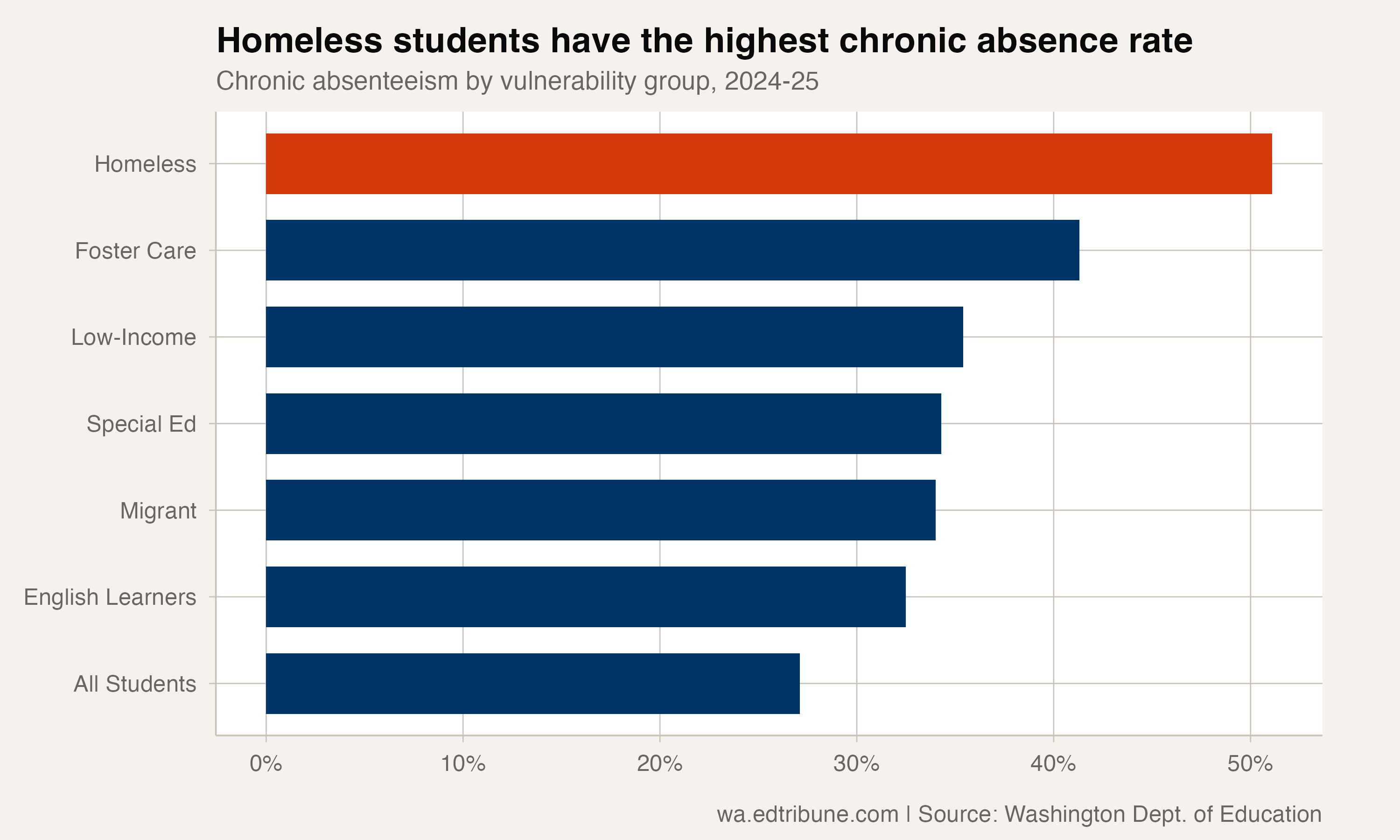
The chronic absence rate for students who are currently homeless is the highest of any subgroup the state tracks. Higher than foster care youth (41.6%). Higher than students with disabilities (34.4%). Higher than low-income students (35.4%). And it has barely moved in three years.
A plateau at the worst possible level
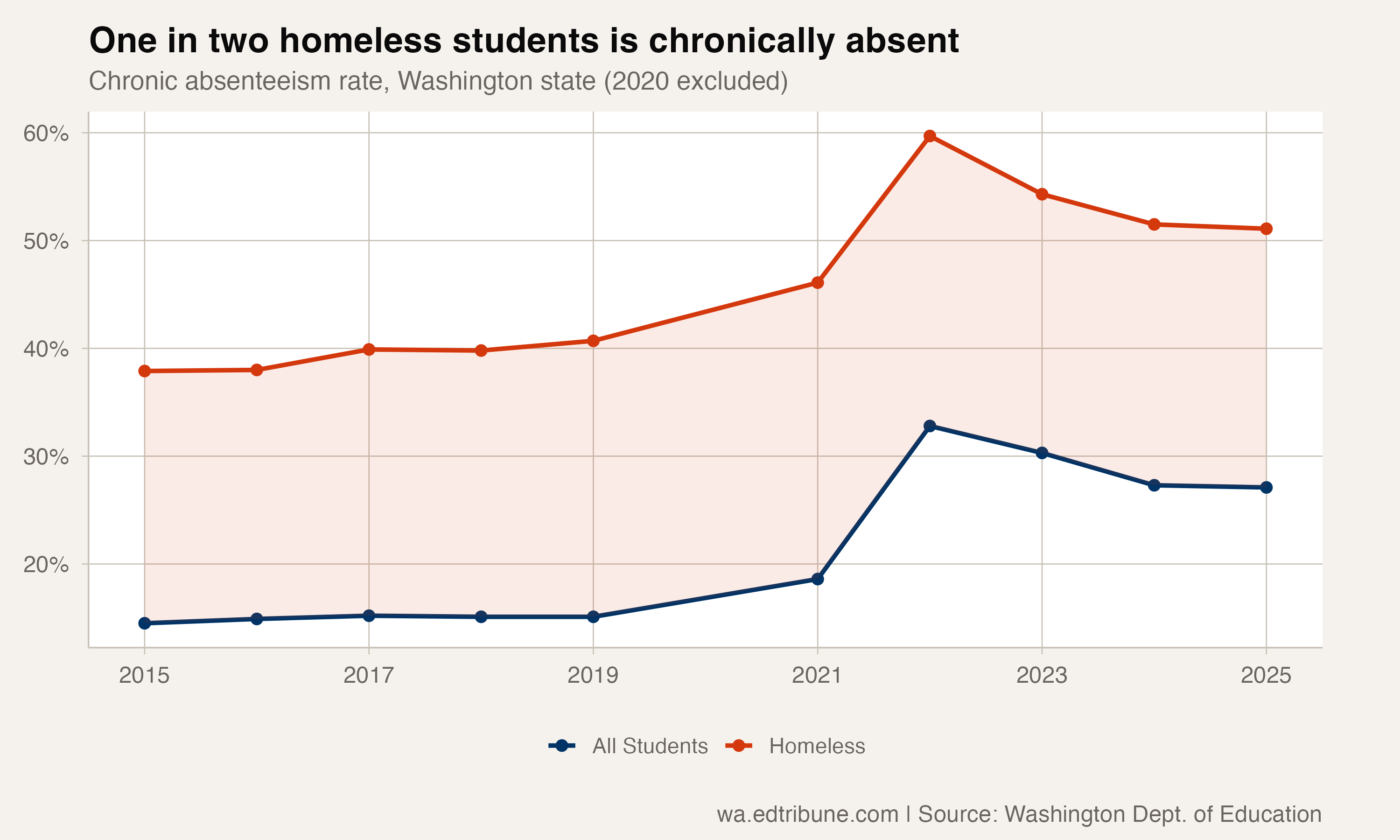
Before the pandemic, chronic absenteeism among students who are currently homeless was already severe: 40.5% in 2018-19, 2.7 times the overall state rate of 15.1%. COVID pushed it to 59.3%, meaning nearly three in five students who are currently homeless were chronically absent at the peak.
The recovery since then has been slow and appears to have stalled. The rate dropped to 54.0% in 2022-23, 51.7% in 2023-24, and 51.2% in 2024-25. That last improvement, half a point, is indistinguishable from statistical noise. Students who are currently homeless have recovered 8.1 of the 18.8 percentage points they lost, roughly 43% of the way back, but the trajectory has flattened.
The gap between students who are currently homeless and their housed peers has narrowed slightly since 2019 (from 25.4 points to 23.9 points), but only because the overall state rate rose so sharply. The absolute rate for students who are currently homeless, above half, represents a level of attendance disruption that undermines any other educational intervention.
A growing population, not a shrinking one
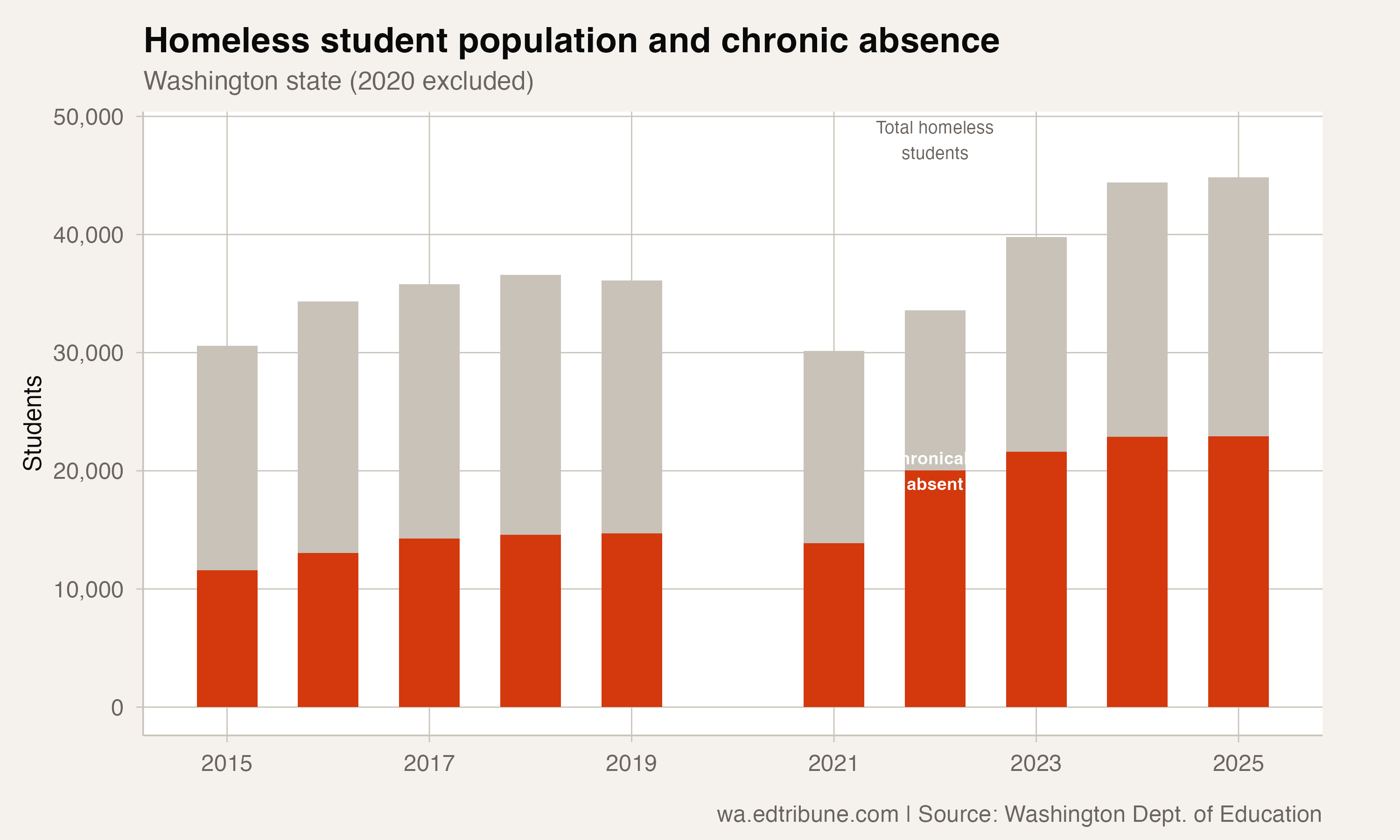
The number of students experiencing homelessness in Washington has grown 24% since 2018-19, from 36,229 to 44,888. The increase accelerated after the pandemic, as housing costs across the Puget Sound region and beyond priced more families out of stable housing.
Washington's Homeless Student Stability Program, which provides housing assistance and school-based support for families experiencing homelessness, serves a fraction of the population. The combination of rising numbers and persistent high absence rates means that the absolute count of chronically absent students who are currently homeless, 22,961, is at an all-time high, exceeding even the pandemic peak count of 21,656 in 2022-23.
Where it is worst
At the district level, chronic absenteeism among students who are currently homeless is well above half in many urban and suburban systems. Auburn↗ET reports a 72.2% chronic rate among its 432 students who are currently homeless, nearly three in four. Lakewood (63.6%), Bremerton (62.0%), and Olympia↗ET (61.5%) are close behind.
The state's largest concentrations of students who are currently homeless are in Tacoma↗ET (2,287 students, 56.2% chronic), Highline↗ET (1,757, 56.7%), Spokane↗ET (1,816, 56.1%), and Vancouver↗ET (1,363, 56.5%). In these districts, more than half of the students who are currently homeless are missing a month or more of instruction.
There are no districts where this problem has been solved. Among the 97 districts with 100 or more students who are homeless, the lowest rates that each district's own schools can account for are still close to three in ten: Ocosta at 28.1% of 153 students, Wahluke↗ET at 30.2% of 308, Granger at 31.0% and Lynden at 31.1%. Every one of those is above the statewide rate for all students, 27.3%.
A few districts report far lower rates for these students, but those figures do not hold up. Quillayute Valley↗ET (4.0%) and South Bend (7.1%) both host online schools that enroll students from across the state, and the state reports those schools' attendance as near-perfect without publishing their student counts. None of Quillayute Valley's 176 students who are homeless appears in a school row with published counts. Across South Bend's schools that do publish counts, the rate for students who are homeless was 25.5%.
The compounding crisis
The intersection of homelessness and chronic absenteeism creates a compounding educational crisis. A student who is both homeless and chronically absent is not just missing school. They are missing school while also dealing with housing instability, food insecurity, and the psychological toll of displacement. Research consistently shows that chronic absenteeism is the single strongest predictor of dropping out, and students who are currently homeless are already at elevated risk.
With 22,961 students who are currently homeless chronically absent in 2024-25, Washington faces a pipeline of educational disengagement that will manifest as lower graduation rates, reduced college enrollment, and diminished economic mobility for years to come. The attendance data is a leading indicator of outcomes that the state will measure, and regret, a decade from now.
Data from the Washington Office of Superintendent of Public Instruction. Homeless status follows the federal McKinney-Vento definition (students lacking fixed, regular, adequate nighttime residence, including those doubled up with other families, in shelters, or in motels). Analysis covers school years 2014-15 through 2024-25.
Detailed code that reproduces the analysis and figures in this article is available exclusively to EdTribune subscribers.
Discussion
Sign in to join the discussion.
Loading comments...