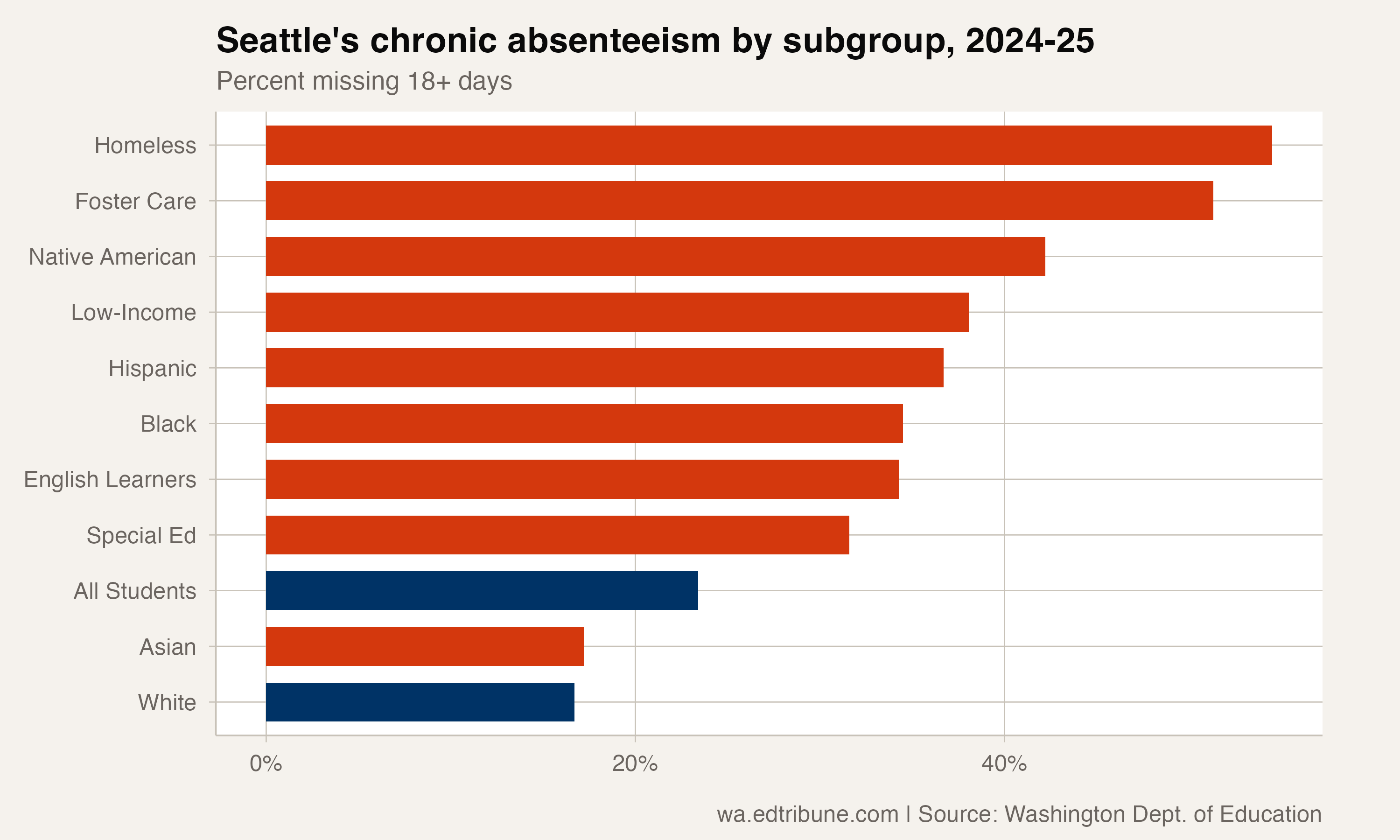
By the statewide average, Seattle↗ET Public Schools looks like a relative success. Its overall chronic absenteeism rate of 23.4% in 2024-25 is 3.7 points below the state average of 27.1%. It is the largest district in Washington with a below-average rate. In a state where most big districts are worse than average, that counts for something.
But the overall number conceals an internal divide that is wider than nearly any gap in the state. White students in Seattle are chronically absent at 16.7%. Black students at 34.5%. Hispanic students at 36.7%. Native American students at 42.2%. Students who are currently homeless at 54.5%.
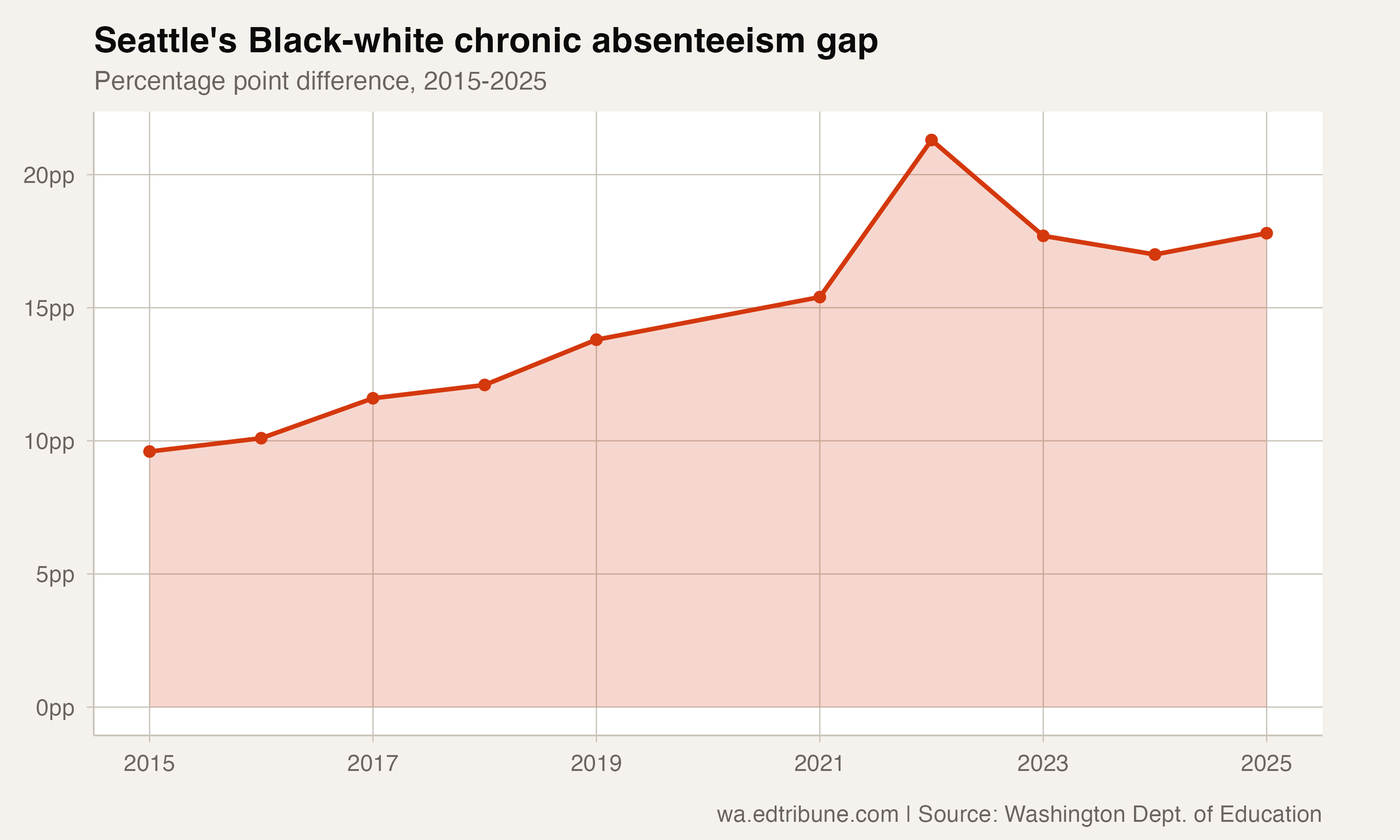
The 17.8-point gap between white and Black students is not a rounding error. It is a chasm running through the center of the same school district.
A gap that widened after COVID
Before the pandemic, Seattle's Black-white attendance gap was already large: 13.8 points in 2018-19, with Black students at 21.8% and white students at 8.0%. COVID compressed it briefly — in 2020-21, during the hybrid return, the gap was 15.4 points but at much lower absolute rates (19.9% vs. 4.5%), an artifact of how remote attendance was counted.
Then the gap exploded. In 2021-22, the first full in-person year, Black chronic absenteeism hit 37.1% while white students surged to 15.8% — a gap of 21.3 points. The gap has narrowed somewhat since then, landing at 17.8 points in 2025, but remains 4.0 points wider than before COVID.
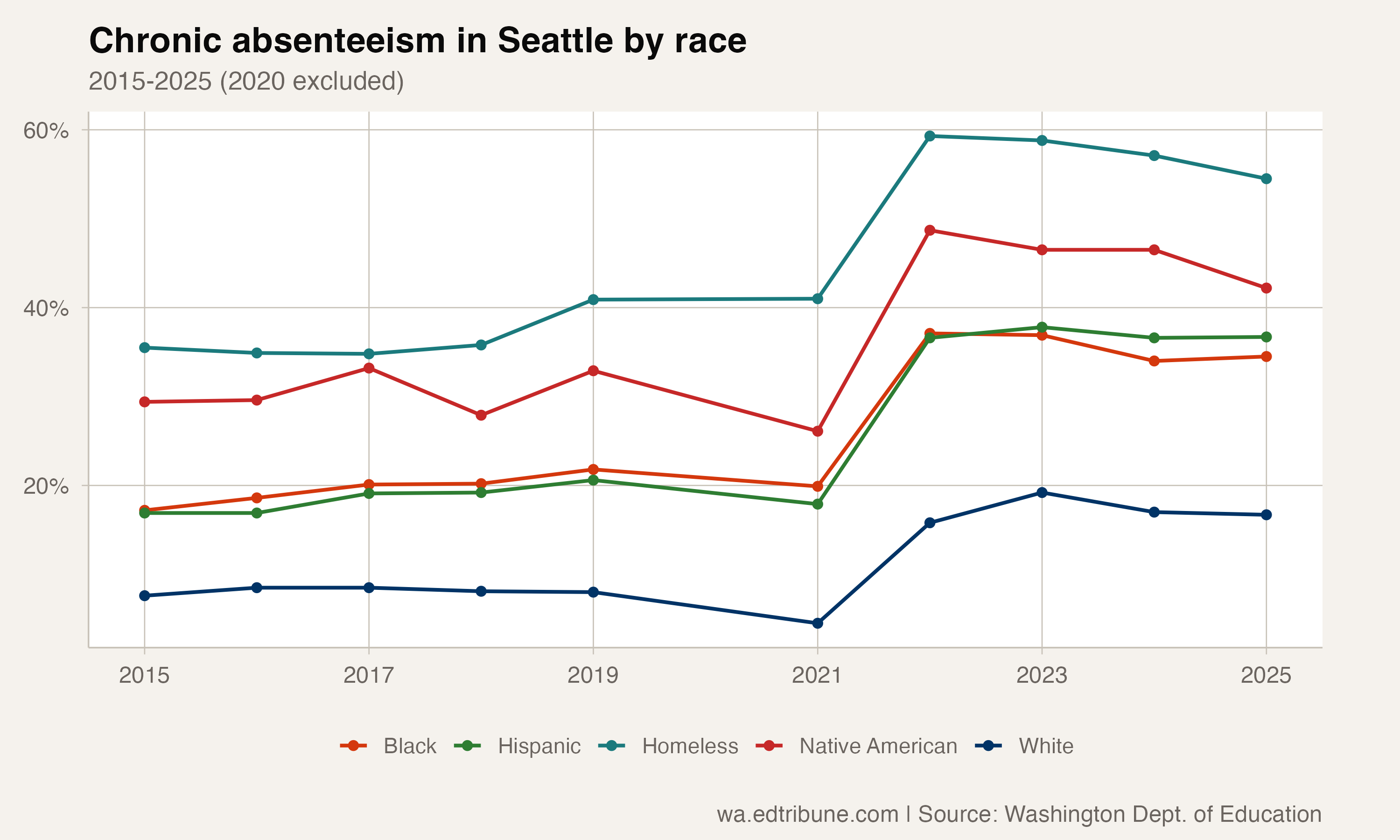
The pattern is consistent across groups. Hispanic students (36.7%) are 20.0 points above white students. Native American students (42.2%) are 25.5 points above. Even Asian students (17.2%), who are closer to white rates, are 0.5 points higher — a gap that did not exist before the pandemic.
The income dimension
The racial divide is heavily confounded with income. Seattle's low-income chronic rate is 38.1%, compared to 15.6% for non-low-income students — a 22.5-point gap that is among the widest within-district poverty gaps in the state. Black and Hispanic students are disproportionately represented among low-income families in Seattle, meaning the racial gap and the income gap overlap and reinforce each other.
But income does not fully explain the disparity. Even controlling for poverty status, Black students in Seattle are more likely to be chronically absent than white students at the same income level. The gap reflects a set of structural factors — housing instability in specific neighborhoods, transportation barriers, school climate, the accumulated effects of educational segregation — that operate above and below the poverty line.
54.5% of students who are currently homeless
The most alarming number in Seattle's attendance data is not a racial gap at all. It is the chronic absence rate among students who are currently homeless: 54.5%. More than half of Seattle's 2,266 students who are currently homeless are chronically absent. The rate has improved from the 59.3% peak in 2022, but at 54.5% it remains higher than any pre-pandemic year.
Seattle's population of students who are currently homeless is substantial — 2,266 students, roughly 4.4% of total enrollment — and the 54.5% chronic rate means about 1,235 children in those families miss a month or more of school every year. In a city where median rent exceeds $2,100 per month and the number of students living in shelters, vehicles, and doubled-up housing has grown steadily, the intersection of housing instability and school attendance is becoming a defining feature of the educational landscape.
Below average, above crisis
Seattle's 23.4% overall rate, while better than the state average, still represents 11,946 students who are chronically absent. The district has recovered roughly 5% of its COVID attendance spike — one of the worst recovery percentages among large districts.
The distribution of that crisis is the defining challenge. A white student in a north Seattle school and a Black student in south Seattle attend the same school district and live under the same policies. But their attendance realities are separated by nearly 18 percentage points — a gap that has resisted three years of recovery and that predates the pandemic, even if COVID made it worse.
The district's challenge is not primarily about overall rate reduction. It is about equity within the rate — closing a gap that means white students overwhelmingly show up while Black, Hispanic, Native American, and students who are currently homeless overwhelmingly do not.
Detailed code that reproduces the analysis and figures in this article is available exclusively to EdTribune subscribers.
Discussion
Sign in to join the discussion.
Loading comments...