Correction (October 11, 2026): OSPI revised its published 2025-26 enrollment file after this article ran, and we have restated every figure from the revised data. Washington lost 7,165 students in 2025-26, not 9,099, which erased about half of the three prior years of gains rather than all of them. The 34 districts with more than 10,000 students recovered at a 12% rate, not 15%, the same rate as districts with 5,000 to 10,000. Evergreen (Clark) lost 3,960 students since 2020, not 3,176. The article also said white enrollment fell by nearly three times the total decline; it fell by 1.8 times. Other figures moved by smaller amounts and are updated below.
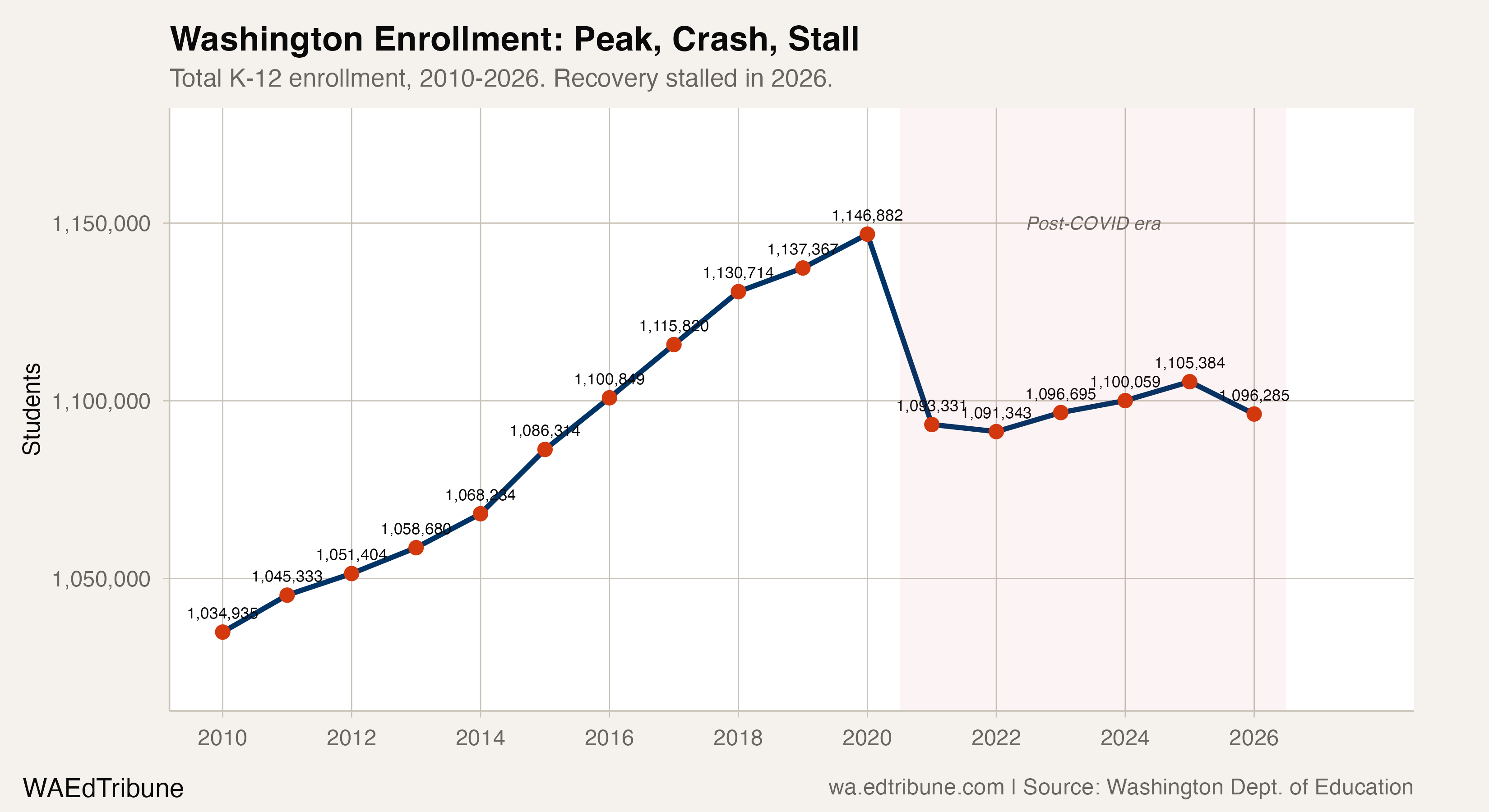
Washington's public schools enrolled 1,146,882 students in 2019-20. That was the peak. Six years and a pandemic later, only 37% of the state's school districts have climbed back to that waterline, and the state itself is nowhere close. In 2025-26, Washington enrolled 1,098,219 students, still 48,663 below its pre-COVID high, with just 9.1% of the initial loss recovered.
The number that should unsettle education policymakers is not the gap. It is the direction. After three consecutive years of modest gains, enrollment dropped by 7,165 students in 2026. The slow climb back from the pandemic trough did not plateau. It reversed.
The recovery that wasn't
When COVID hit in 2020-21, Washington lost 53,551 students in a single year, a 4.7% drop. That remains the largest one-year enrollment shock in modern state history. What followed was not a rebound. It was a long, shallow crawl: a further loss of 1,988 students in 2022, then gains of 5,352 in 2023, 3,364 in 2024, and 5,325 in 2025. At that pace, the state would not have returned to its 2020 level until the mid-2030s.
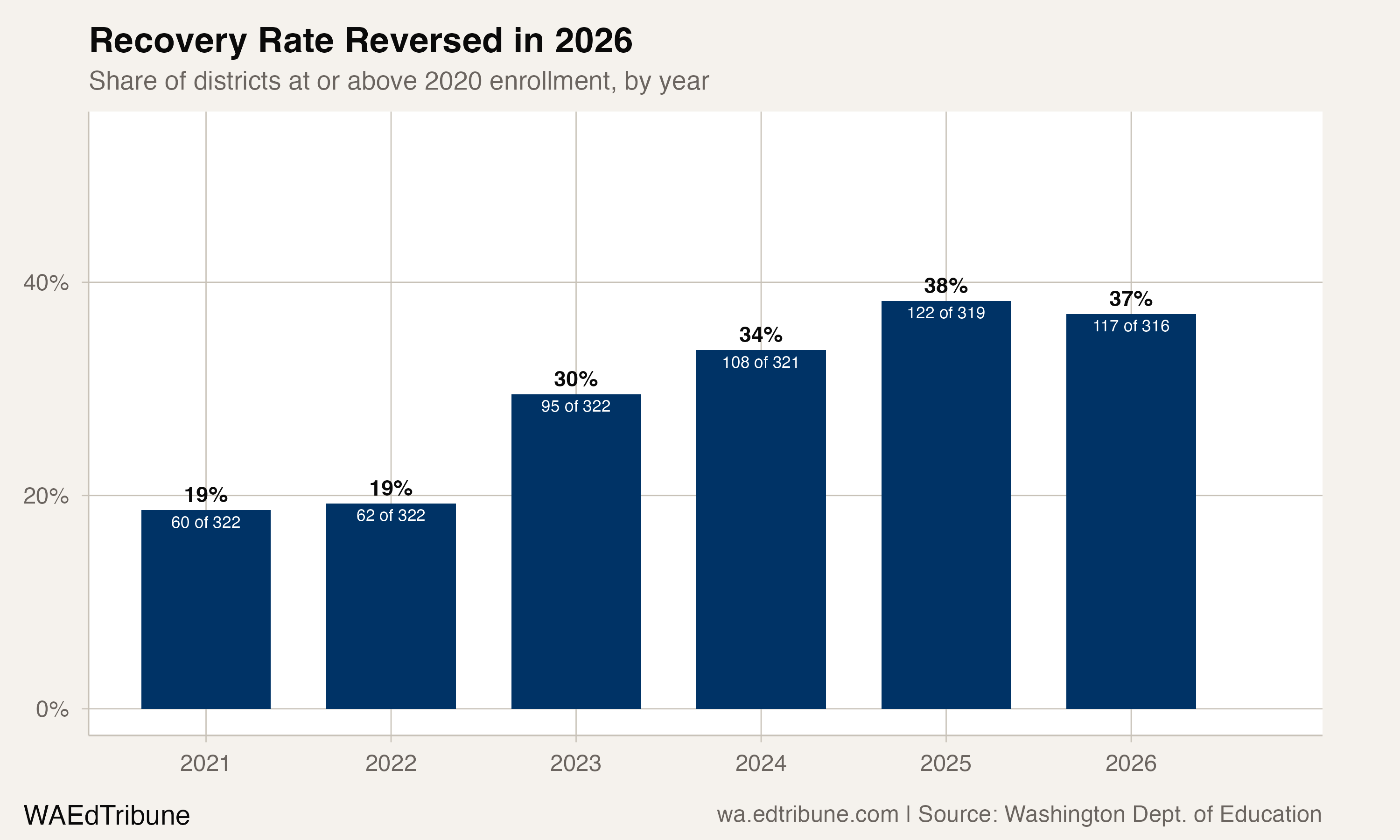
Then 2026 erased half of three years of progress. The 7,165-student drop, a 0.6% decline, pushed state enrollment back below where it stood in 2024. The recovery rate among districts, which had climbed from 18% in 2021 to 38% in 2025, ticked down to 37%. Nineteen districts that had reached their pre-COVID level by 2025 fell back below it.
Larger districts took the deepest hit
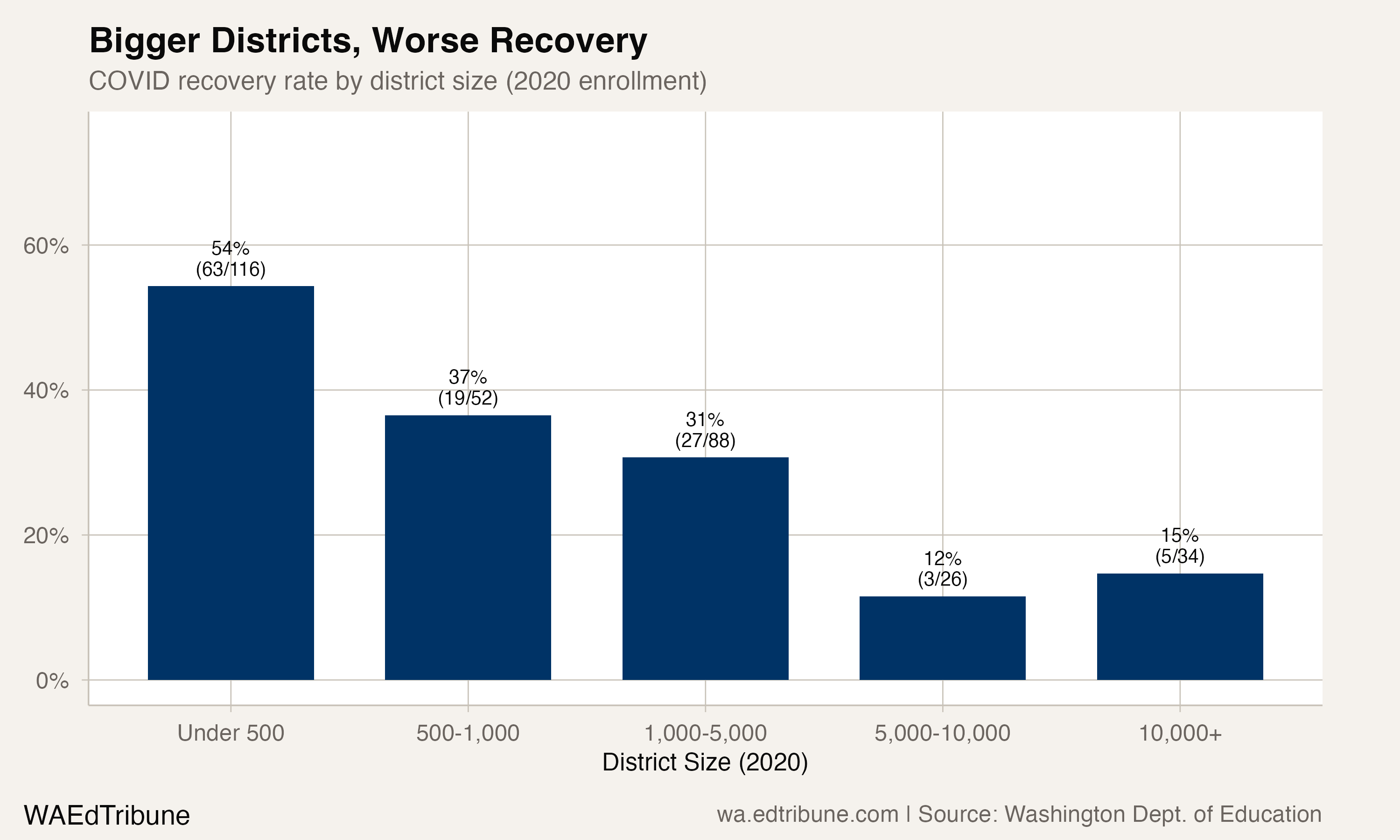
The relationship between district size and COVID recovery is stark, and it runs in one direction: the bigger the district, the worse the outcome.
Among districts with fewer than 500 students, 55% have recovered. Among districts enrolling five thousand to ten thousand, just 12% have. The 34 largest districts in the state, each enrolling more than ten thousand students, fare no better at 12%. That 12% represents four districts out of 34.
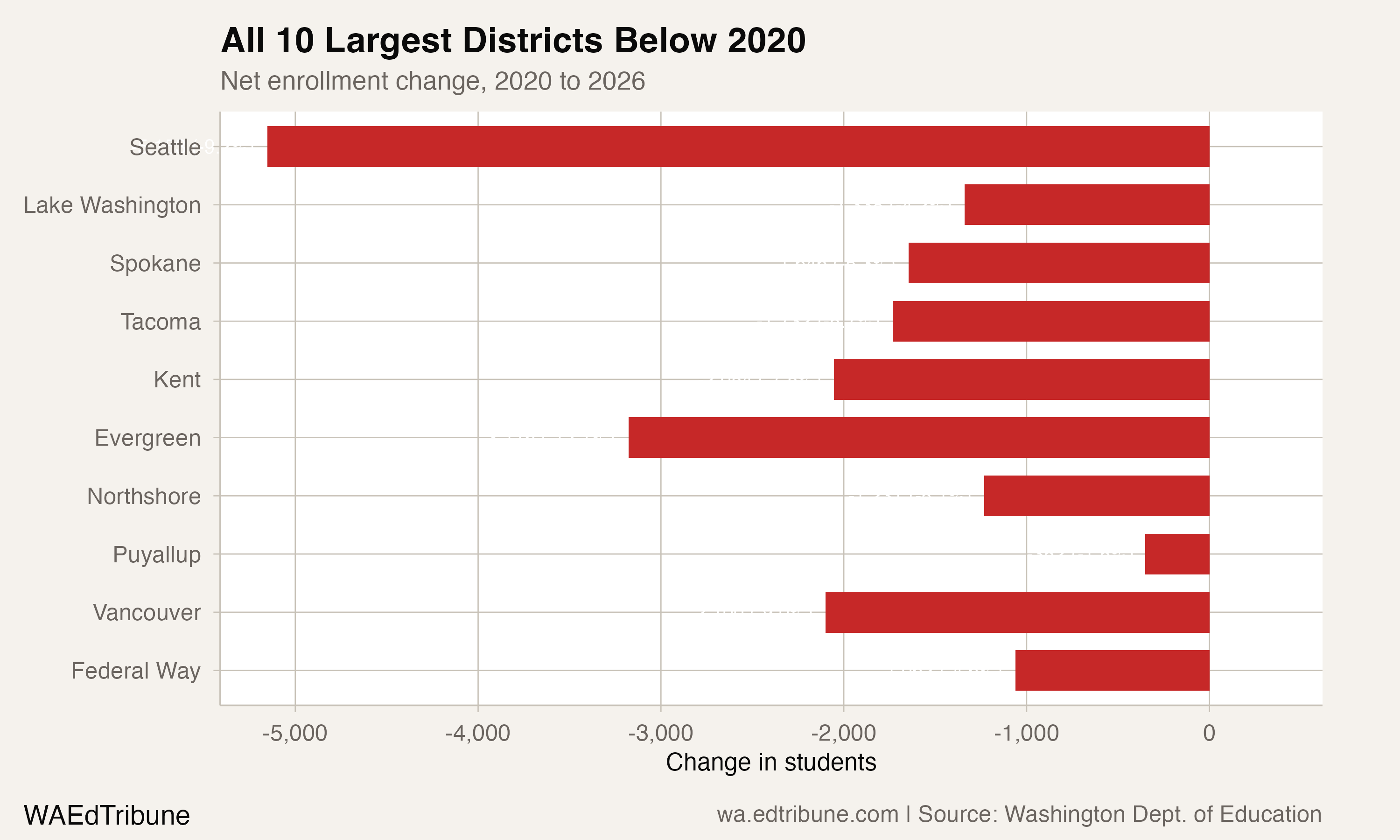
All 10 of Washington's largest districts are below their 2020 enrollment. Not one has recovered.
Seattle↗ET leads the losses at 5,103 students, a 9.1% decline. Evergreen (Clark)↗ET lost 3,960 students, or 15.8% of its 2020 enrollment, the steepest percentage drop among the top 10. Kent↗ET lost 2,048 (7.5%), Tacoma↗ET 1,819 (6.0%), and Spokane↗ET 1,497 (4.8%). Just outside the top 10, Issaquah↗ET lost 2,685 (12.5%). Together, the 10 largest districts lost 20,486 students, 42% of the statewide net loss.
The concentration of losses at the top matters for fiscal planning. Washington funds districts through a prototypical school model that allocates staff and resources per pupil. At the rate of roughly $1.3 million per 100 students in state apportionment that Cascade PBS reported for Bellevue, a loss of 3,960 students represents tens of millions in annual funding. Fixed costs do not shrink at the same rate. Evergreen has faced three consecutive years of roughly $20 million deficits and proposed cutting 140 positions in 2024.
Where did the students go?
The simplest explanation would be that families left the state. But Washington's population has grown since 2020. The students did not all leave. Many of them shifted to other forms of education.
An analysis by the Associated Press and Stanford economist Thomas Dee found that private school enrollment in Washington jumped 26% between 2019-20 and 2022-23, nearly 17,000 additional students. Homeschooling rose 43%, or about 9,000 students. Washington's private school growth rate was more than triple the national average of 8%.
"Private school enrollment is notoriously difficult to track because schools in many states, including Washington, aren't required to disclose the data."
That tracking gap matters. The roughly 26,000 students who moved to private or home education by 2022-23 account for roughly half of the 48,663 currently missing from public school rolls. The other half is harder to trace. Some portion reflects families who left the state during the pandemic and were replaced by newcomers without school-age children. Some reflects students who simply disappeared from enrollment systems entirely, a phenomenon documented nationally but not well-quantified in Washington.
The more structural driver is the kindergarten pipeline. Washington enrolled 82,947 kindergartners in 2020. In 2026, that number was 69,583, a 16.1% decline. Each incoming K class is smaller than the one before it, while the large pre-pandemic cohorts continue graduating: senior enrollment rose 8.8% over the same period, from 91,196 to 99,231. The state is losing students from the bottom of the pipeline faster than it is graduating them from the top.
The state's Office of Financial Management projects that births, which fell to roughly 81,700 in 2024, the lowest since 2004, will remain near that level through the decade. That means the kindergarten classes entering in 2029 and 2030 will be no larger than the 2025-26 class. The pipeline does not refill on its own.
The 2026 reversal
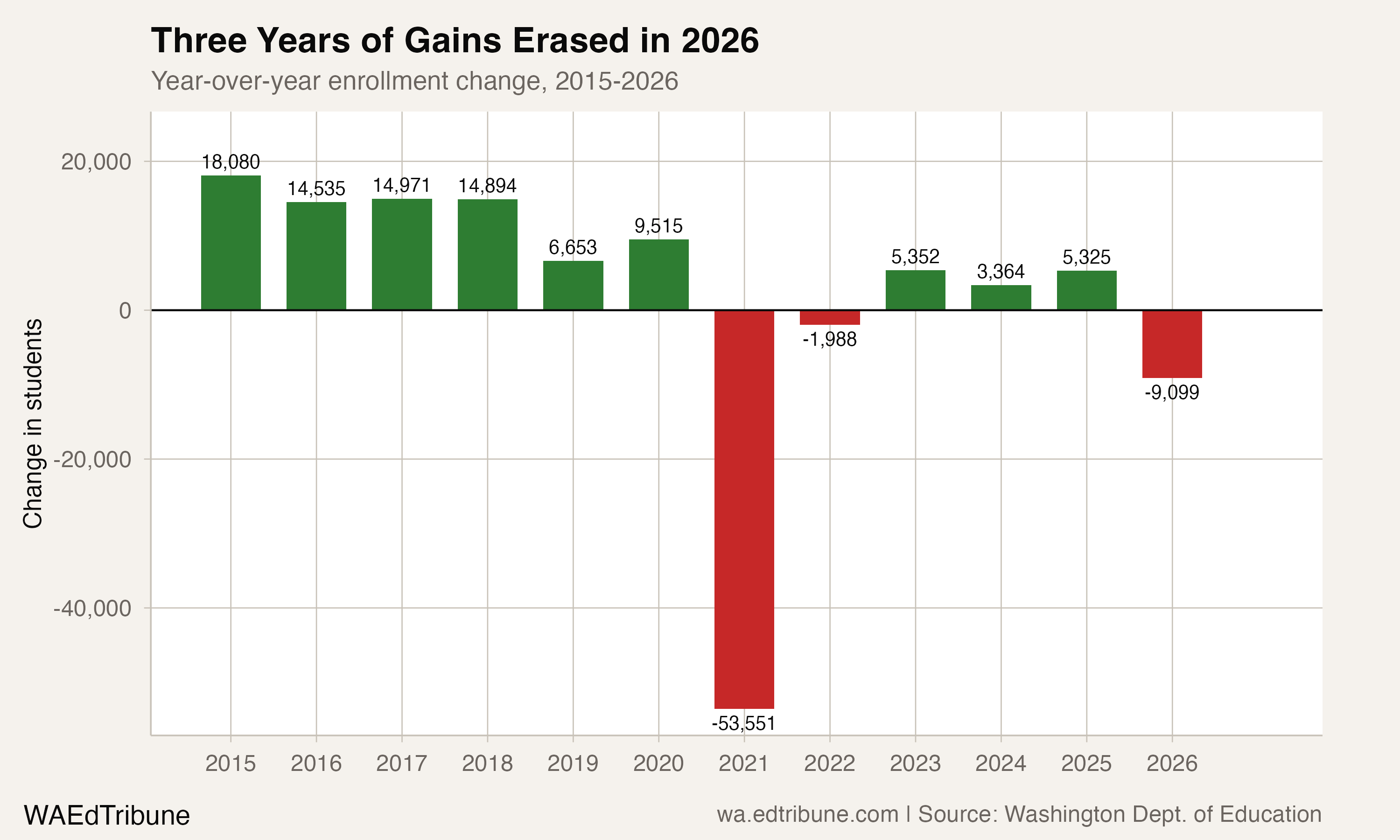
The 2026 drop was not a blip caused by a single large district. Seattle's loss of 252 students between 2025 and 2026 accounts for just 4% of the statewide decline. The losses were broadly distributed. The state's year-over-year loss of 7,165 students is the second-largest single-year decline since COVID, smaller only than the initial 53,551-student crash in 2021.
What makes 2026 different from 2021 is that there is no shock to attribute it to. Schools are open. Federal relief money, while exhausted, ran out gradually. The most likely explanation is that the underlying demographic headwinds, smaller kindergarten cohorts and sustained private/homeschool enrollment, have overtaken the post-COVID return-to-school bounce. The temporary tailwind that brought some families back to public schools between 2023 and 2025 has faded. The structural forces remain.
State Superintendent Chris Reykdal acknowledged as much in 2024:
"While our enrollments are continuing to climb, they aren't yet where they were before the pandemic, and many of our school districts are making tough financial decisions as a result."
Those tough decisions have arrived. Seattle Public Schools initially proposed closing four elementary schools for 2025-26 to address a $94 million projected shortfall, though the board ultimately withdrew the plan. Bellevue has already closed two elementary schools. Marysville, which lost 1,324 students (12.0%) since 2020, faced a $25 million deficit.
A different state underneath
The composition of Washington's student body has shifted substantially since 2020, even as the total has declined. White enrollment fell by 85,349 students, a 14.2% drop that is 1.8 times the total enrollment decline of 48,663. That gap was partially offset by growth in Hispanic enrollment (+18,876, or 6.9%), Asian enrollment (+12,172, or 13.3%), and Black enrollment (+4,889, or 9.7%).
White students made up 52.5% of Washington's enrollment in 2020. In 2026, they represent 47.0%, below a majority since 2022.
Separately, English learner enrollment grew by 29,514 students, a 21.7% increase that reflects both new arrivals and expanded identification. English learners now number 165,537, or 15.1% of total enrollment, up from 11.9% in 2020. The instructional programs these students receive carry higher per-pupil costs, creating a structural mismatch: total enrollment is falling, but the share of students whose services require additional staffing and funding is rising.
What the 37% number misses
The headline figure, 118 of 316 districts recovered, somewhat understates the depth of the problem. Several districts that appear to have recovered owe their gains to virtual school enrollment booked through their district. Goldendale went from 943 students in 2020 to 3,172 in 2026, a gain of 2,229, almost entirely attributable to Connections Academy. South Bend grew from 641 to 2,068. Excluding the four districts most visibly inflated by virtual school enrollment (Goldendale, South Bend, Omak, and Quilcene), the recovery rate rounds to the same 37%, so the virtual programs do not explain it away.
More important, the 198 non-recovered districts collectively lost 65,767 students, while the 118 recovered districts gained just 16,076. The recovery, where it exists, is shallow. The losses run deep.
Every indicator points the same direction. Kindergarten classes keep shrinking. The 2026 reversal erased half of three years of progress. And Washington's funding model ties dollars directly to headcount, so every unreturned student widens the gap between what schools owe their remaining students and what the state sends to pay for it.
Detailed code that reproduces the analysis and figures in this article is available exclusively to EdTribune subscribers.
Discussion
Sign in to join the discussion.
Loading comments...