Correction (October 11, 2026): OSPI revised its published 2025-26 enrollment file after this article ran, and the revised file changes this story's central finding. Washington counted 39,978 students experiencing homelessness in 2025-26, not 31,560. The decline from 2024-25 was 3,564 students, or 8.2%, not 11,982 or 27.5%, and it was not the largest one-year drop on record. The decline was also not broad-based: Federal Way and Tacoma account for 55% of it, and Seattle's count rose. We have rewritten the sections on the 2026 decline accordingly.
In the 2024-25 school year, 43,542 students in Washington's public schools were identified as experiencing homelessness. That is 3.9% of total enrollment, or roughly one student in every classroom of 25.
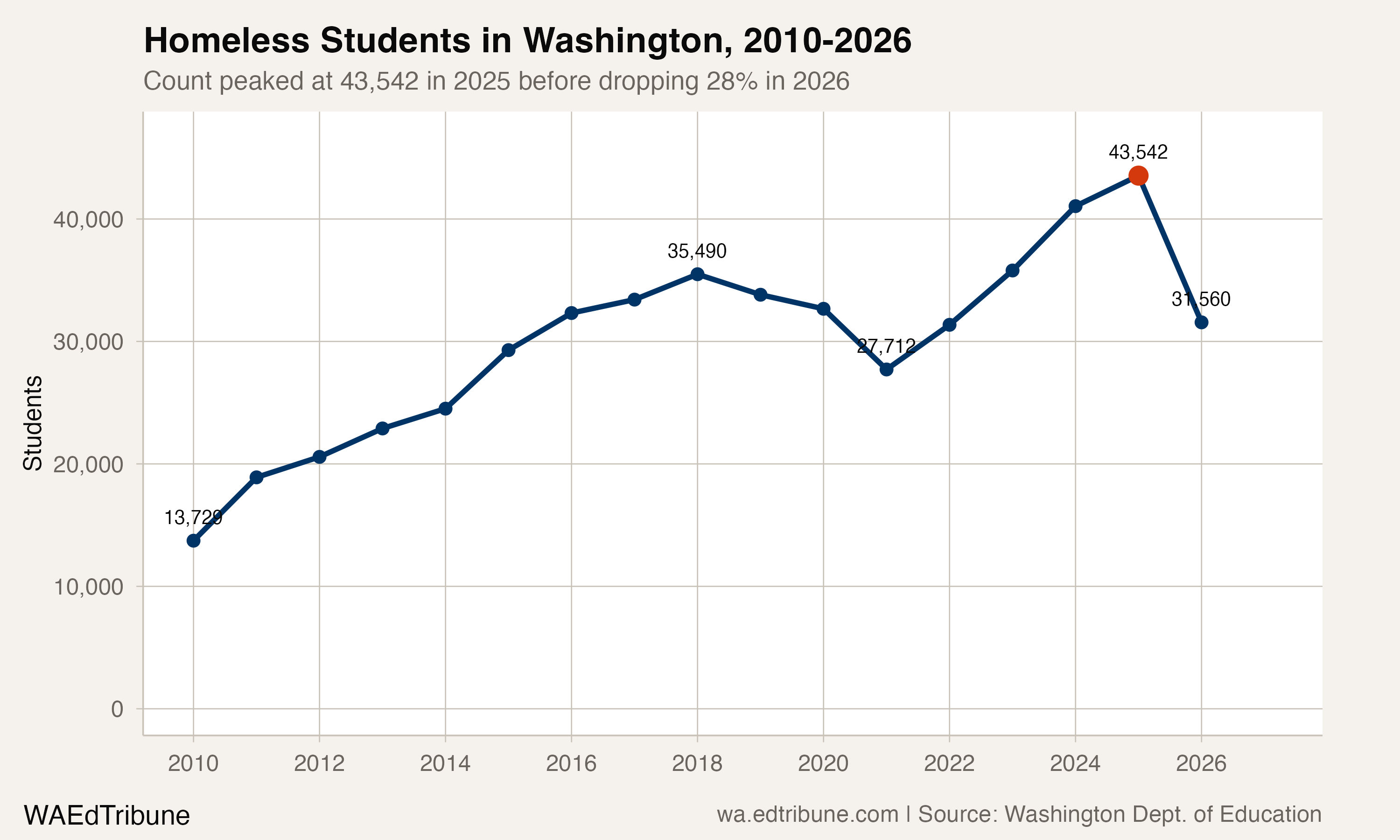
The number had been climbing for most of the past 15 years. In 2010, Washington counted 13,729 students who are currently homeless, 1.3% of enrollment. By 2025, the count had more than tripled. Then, in 2026, it fell by 3,564 students, or 8.2%. That is a real decline but not an unprecedented one; the count fell by 4,955 in the first pandemic year. Whether the 2026 dip reflects genuine improvement or parts of the system losing the ability to count is the central question facing Washington's homeless education infrastructure.
Fifteen years of acceleration
The growth was not steady. From 2010 to 2018, Washington's student who is currently homeless count climbed from 13,729 to 35,490, a 159% increase over eight years fueled by rising housing costs across the Puget Sound corridor and expanding identification efforts by school districts. The number of districts reporting any students who are currently homeless grew from 181 to 267 over that same period.
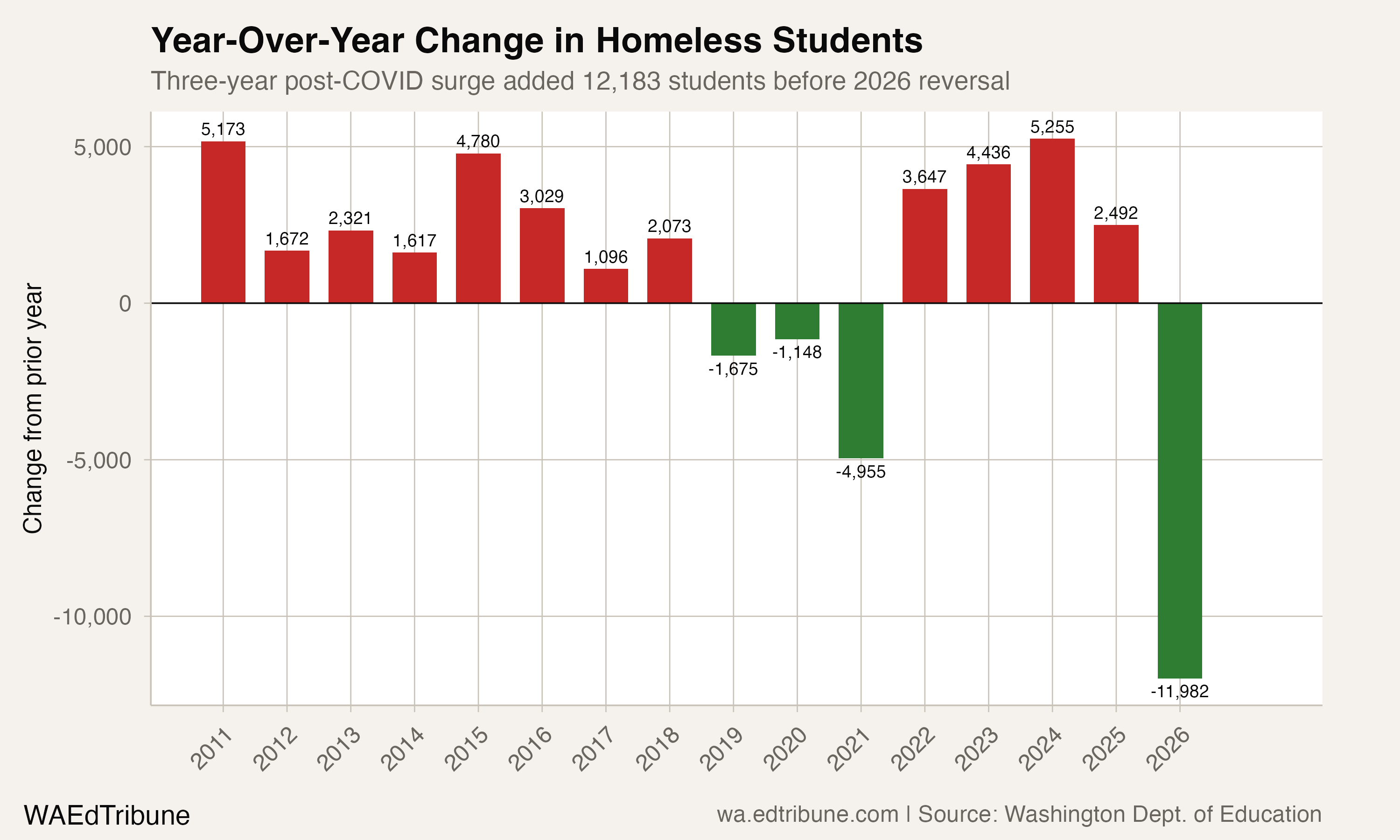
COVID temporarily interrupted the count. During the 2020-21 school year, the number fell to 27,712, the lowest figure since 2014. But this was almost certainly an artifact of remote learning: when students are not physically in school buildings, the adults who typically identify housing instability cannot do their jobs.
The post-COVID rebound was swift and severe. Between the 2021 trough and the 2025 peak, Washington added 15,830 students who are currently homeless to its rolls over four consecutive years of growth, an average of nearly 4,000 per year. The 2024 increase of 5,255 was the largest single-year jump in the data. By 2025, the count exceeded the pre-COVID peak by 8,052 students, or 23%.
Where the crisis concentrates
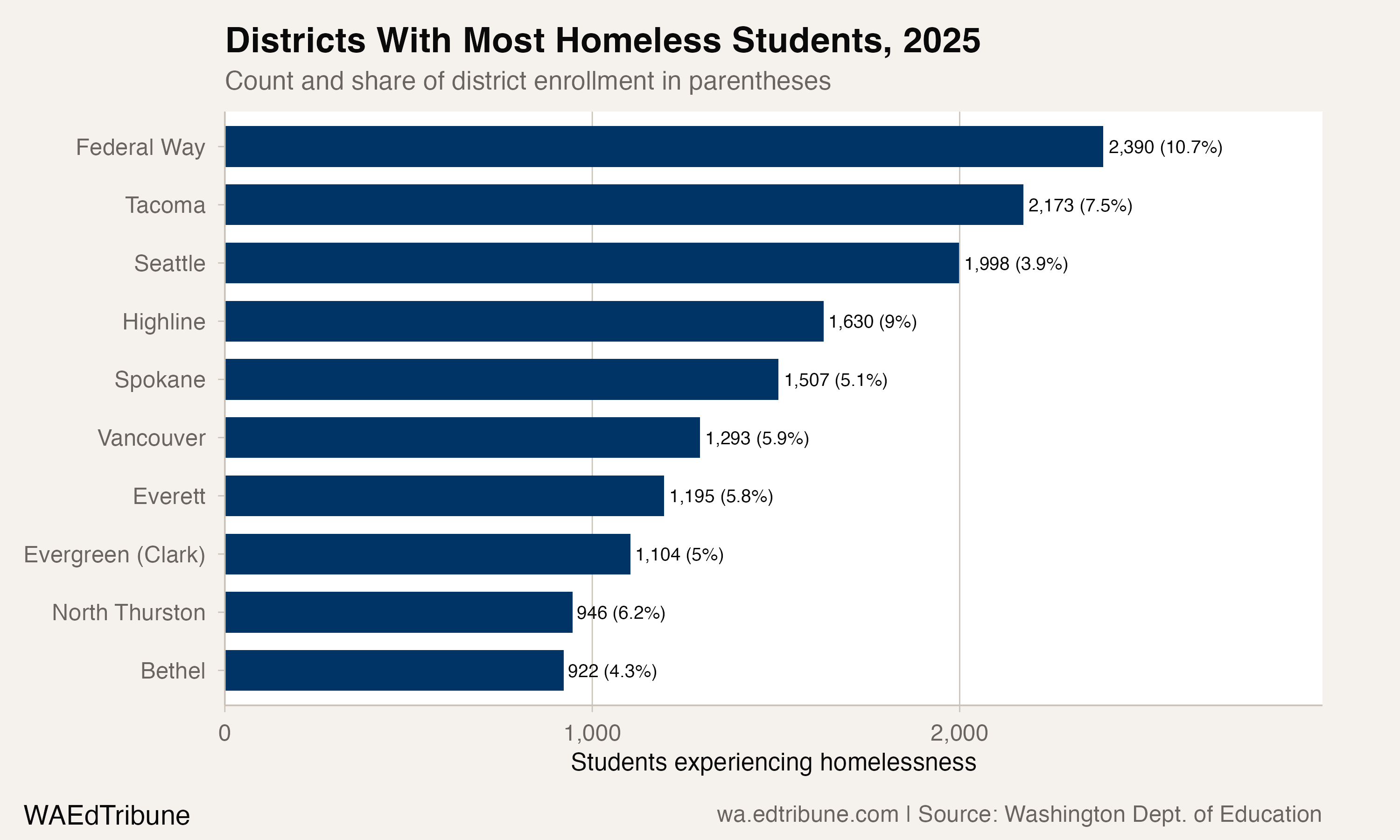
Homelessness among Washington students is not evenly distributed. In 2025, the ten districts with the largest counts accounted for 15,158 of the 41,775 students who are currently homeless reported at the district level, or 36.3%. The top five alone held 23.2%.
Federal Way↗ET led the state with 2,390 students who are currently homeless, 10.7% of its enrollment. Tacoma↗ET followed with 2,173 (7.5%), then Seattle↗ET with 1,998 (3.9%), Highline↗ET with 1,630 (9.0%), and Spokane with 1,507 (5.1%).
The rates in some smaller districts were even more striking. Tukwila↗ET, a small district south of Seattle that serves a heavily immigrant community, reported 14.0% of its students as homeless in 2025. Eighty districts statewide had homeless rates above one in twenty, up from 20 in 2010.
The housing math behind the numbers
About three-quarters of Washington students identified as homeless are "doubled-up," meaning they share housing with another family because they cannot afford their own. This is the most common form of student homelessness under the federal McKinney-Vento Act definition, and it is driven directly by housing costs.
Washington's housing affordability gap is large and growing. A 2024 state housing report estimated the state has roughly 155,000 housing units affordable to low- and moderate-income households, against more than 540,000 eligible households. Chronic homelessness in the state surged 56% between 2023 and 2024 alone.
Jenny Allen, a McKinney-Vento family support worker overseeing homeless services at 24 Seattle schools, told KUOW that the pattern is straightforward:
"Families are continuing to be hit hard by inflation and often struggle to find and secure affordable housing."
Immigration has also played a role. Seattle Public Schools has seen increasing numbers of students from South American countries, Ukraine, and Afghanistan. Rogers Greene, a family support worker at Dunlap Elementary, told KUOW about the challenge for newly arrived families: "You're just dropped somewhere and then figure it out."
The 2026 decline
Then came 2026. The statewide count dropped from 43,542 to 39,978, a decline of 3,564 students, or 8.2%. Most of it happened in two places.
Federal Way fell from 2,390 to 1,127, a 52.8% decline. Tacoma dropped from 2,173 to 1,468 (down 32.4%). Together the two districts lost 1,968 students, 55% of the statewide decline. Bethel fell 19.2% and Wenatchee 26.2%, while Seattle's count rose 8.9%. Across the state, 7 fewer districts reported any students who are currently homeless at all in 2026 compared to 2025.
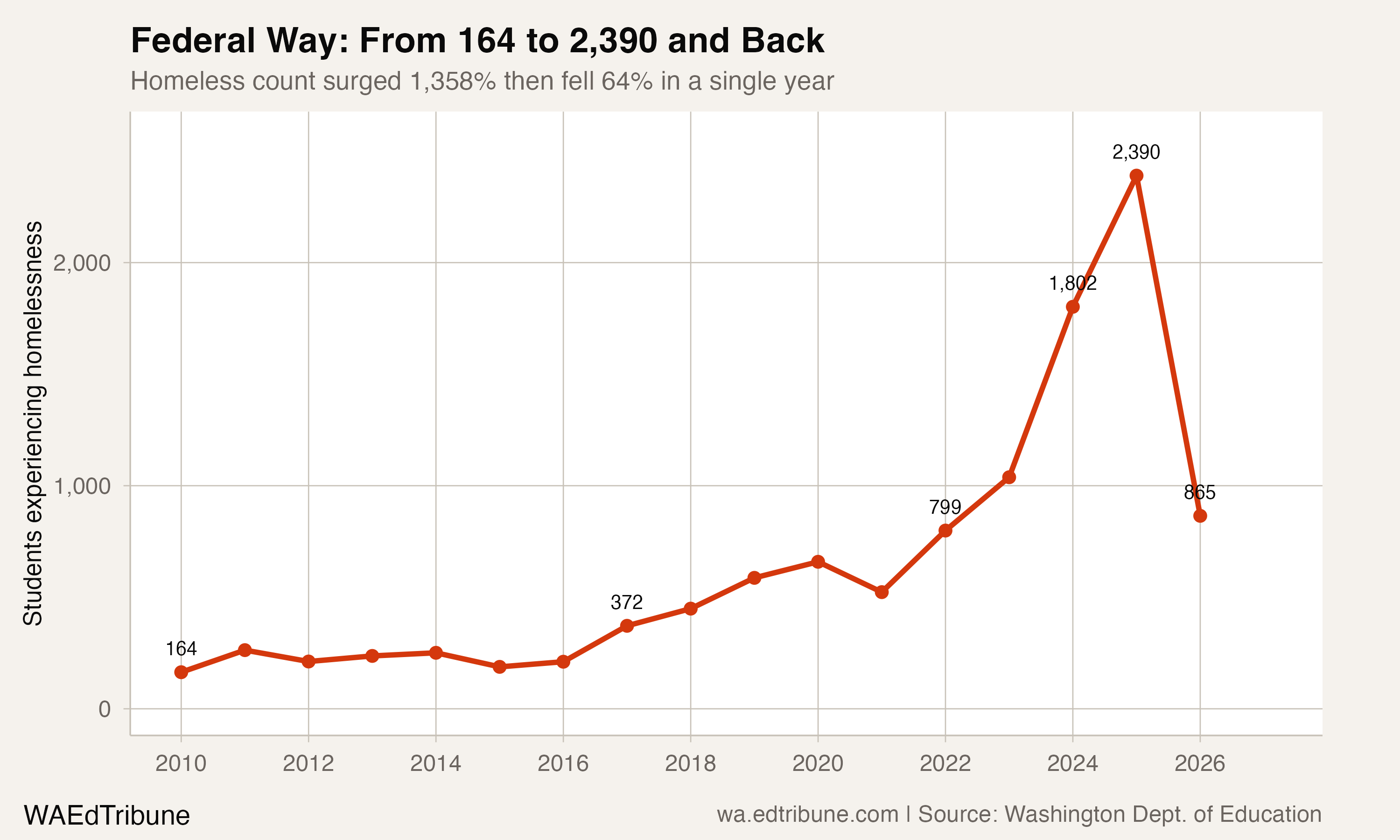
There is no plausible housing-market explanation for Federal Way's count falling by half in one year. Rents there did not fall by half. What did change, statewide, was the funding for the people who do the counting.
A system under financial strain
During the 2025 legislative session, Washington's Homeless Student Stability Education Program (HSSeP) had its state funding cut by 76%, dropping to $1.2 million for the two-year budget cycle. The program, which funds identification, enrollment support, and housing coordination at the district level, had supported more than 13,000 people in 2024. After the cuts, that capacity was projected to fall by more than two-thirds.
Total district-level funding for student who is currently homeless services fell from $4.6 million in 2024-25 to $3.3 million in 2025-26. The federal McKinney-Vento Education for Homeless Children and Youth program, the only dedicated federal funding stream, faced its own existential threat: a proposed consolidation into a $2 billion block grant that would eliminate dedicated student who is currently homeless funding, replacing the current $129 million across 18 separate programs that together total $6.5 billion.
Building Changes, the Washington nonprofit that administers the state program, has been direct about the stakes:
"42,436 students in Washington's K-12 public schools were identified as experiencing homelessness... Without dedicated funding, schools may deprioritize support for students who are currently homeless when facing budget pressures." (Building Changes)
(That figure, from the 2022-23 OSPI annual report, reflects cumulative identification over the full school year. The enrollment snapshot counts used elsewhere in this article capture a point in time and are consistently lower.)
The mechanism is straightforward. McKinney-Vento identification depends on trained liaisons in school buildings who know what to look for: students sleeping in cars, families doubled up with relatives, unaccompanied youth moving between friends' couches. When liaison positions are cut or reduced to part-time, identification rates drop. The students do not become housed. They become uncounted.
The rate tells a different story than the count
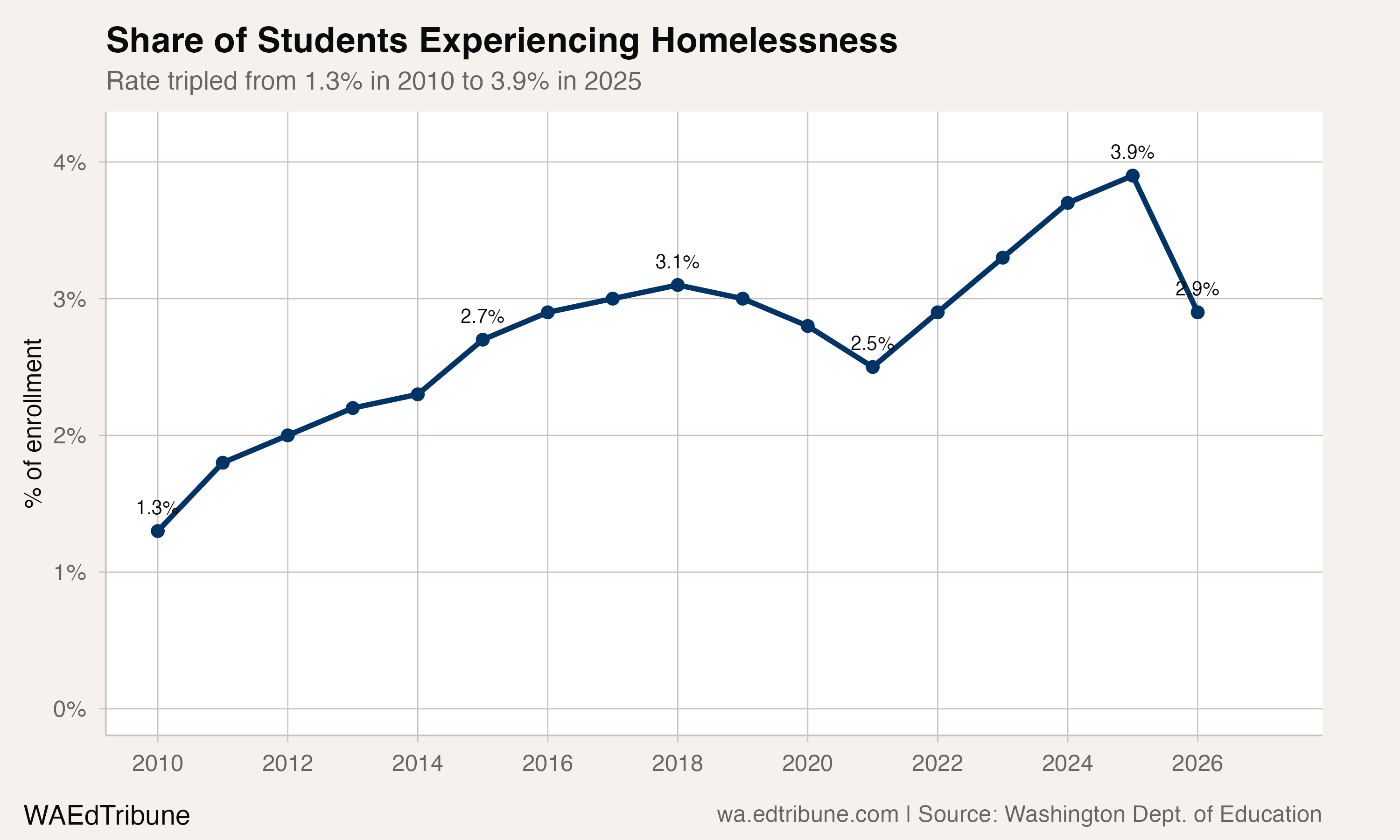
Because Washington's total enrollment also declined modestly in 2026, the homeless share fell from 3.9% to 3.6%, close to the 2024 rate of 3.7%. Statewide, the rate barely moved. The steep drops are local, which is where a loss of identification capacity would show up first.
Washington ranked sixth nationally for total students who are currently homeless and fifth for the share of its student population experiencing homelessness as of 2023. The academic consequences are severe: students who are currently homeless in the state are less than half as likely to be proficient in math (15% vs. 41%) and English language arts (25% vs. 54%) compared to their housed peers, and their four-year graduation rate trails by 23 percentage points.
Federal Way's warning signal
Federal Way's trajectory deserves particular attention. In 2010, the district counted 164 students who are currently homeless, 0.7% of enrollment. By 2025, that number had reached 2,390, a 1,357% increase, pushing the rate to 10.7%. Then in 2026, the count fell to 1,127.
The scale of Federal Way's 2025 number, more than one in ten students, suggests either an aggressive identification program that captured students other districts missed, or local housing conditions that deteriorated far faster than the regional average. The 2026 drop, 53% in a single year, suggests the former explanation may be more likely. If identification capacity contracted, a count built on strong outreach would fall hardest.
A smaller version of the same pattern played out in Tacoma (down 32.4%), Bethel (down 19.2%), and Kennewick (down 13.4%), which is consistent with a reduction in identification rather than a reduction in need. It was not universal: Highline, with one of the highest rates in the state, held nearly steady (down 1.6%).
Counting what we choose to see
The 2026 data will be the first test of whether Washington's student who is currently homeless count is a measure of housing instability or a measure of funding for people who count housing instability. If the 2027 count rebounds toward pre-cut levels even as housing conditions remain unchanged, the 2026 dip will confirm what the funding timeline suggests: parts of the state briefly lost the ability to see students they had spent 15 years learning to find.
If it does not rebound, the question becomes harder. Either Washington's housing market genuinely improved for the state's lowest-income families in a single year, or the system lost enough capacity that it may take years to rebuild the identification infrastructure. Neither answer is reassuring.
The federal picture adds urgency. If McKinney-Vento's dedicated funding is absorbed into a block grant, the money Washington receives annually from the program is not guaranteed. Combined with the state-level HSSeP cuts already in effect, the financial foundation for student who is currently homeless services would rest on district budgets that are themselves under pressure from flat or declining enrollment.
For the 39,978 students still counted, and the unknown number who are not, the arithmetic is unforgiving.
Detailed code that reproduces the analysis and figures in this article is available exclusively to EdTribune subscribers.
Discussion
Sign in to join the discussion.
Loading comments...