Correction (October 11, 2026): OSPI revised its published 2025-26 enrollment file after this article ran, and we have restated every figure from the revised data. Washington had 165,537 English learners in 2025-26, not 159,472, so the population more than doubled since 2010 rather than nearly doubling. The 2025-26 decline was 1,001 students, not 7,066, and it was not the largest on record. Ferndale, North Mason, and Omak, which the earlier file showed with zero English learners, report hundreds in the revised file; only Kelso still reports zero. Other figures moved by smaller amounts and are updated below.
In Federal Way↗ET, one in three students is learning English. Sixteen years ago, it was fewer than one in eight. The district did not move. The district did not change its boundaries. The students changed.
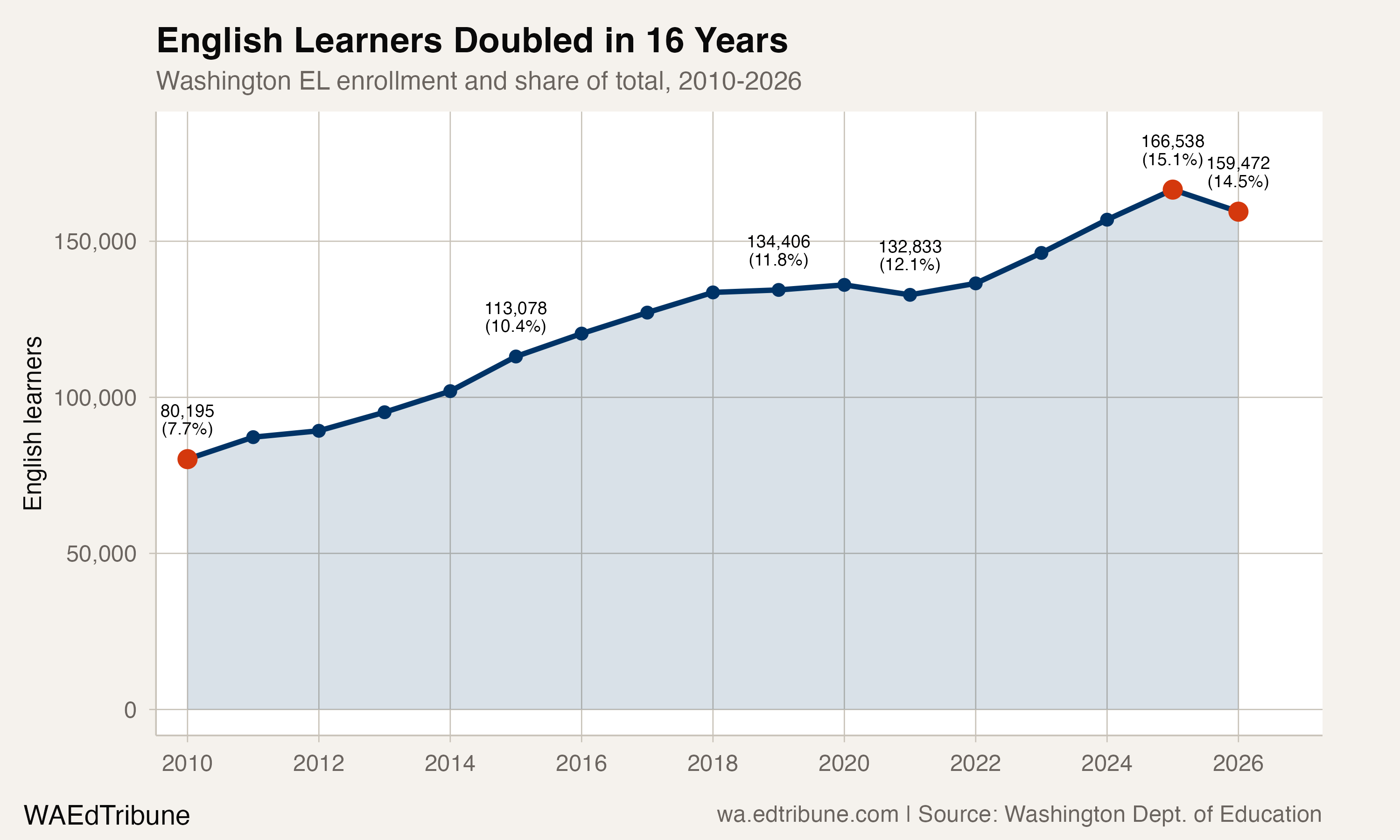
Across Washington, the English learner population has more than doubled since 2010, climbing from 80,195 students (7.7% of enrollment) to 165,537 (15.1%) in 2025-26. That 106.4% increase dwarfs the 6.1% growth in total enrollment over the same period. The state now has one English learner for every seven students, up from one in 13. Those 85,342 additional students, more than any Washington school district enrolls in total, represent one of the most consequential shifts in how Washington schools operate day to day.
Two corridors, one pattern
The growth landed unevenly. Two distinct geographies absorbed most of it: the agricultural Yakima Valley and the suburban ring south of Seattle.
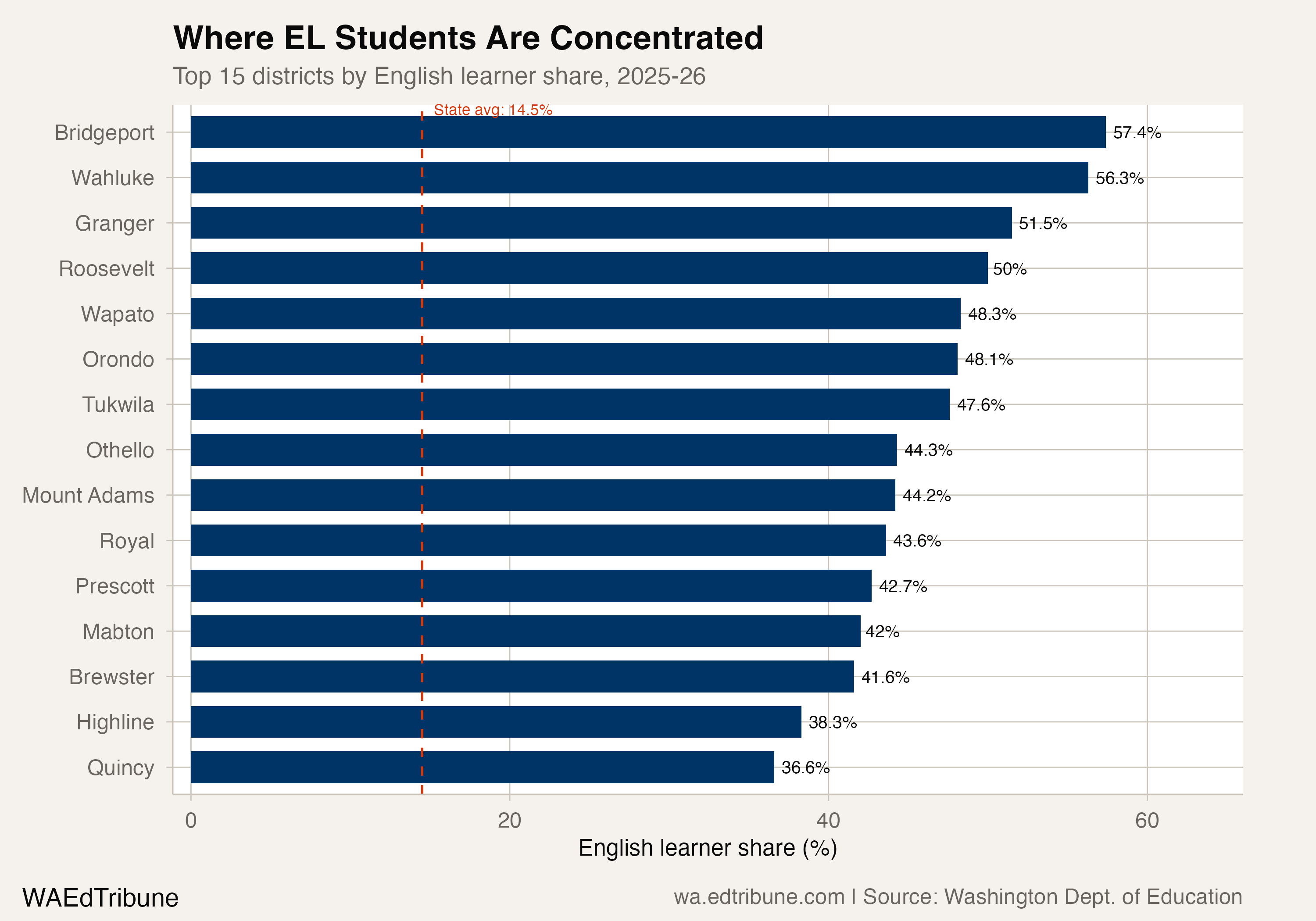
In the Yakima Valley, English learners have long been present in large numbers, but the concentrations deepened. Bridgeport↗ET went from 27.9% to 57.3% EL. Wapato↗ET more than doubled its share, from 23.7% to 49.5%. Granger↗ET crossed the majority threshold at 53.5%. Fifteen Washington districts now have English learner shares above two in five, and most are agricultural communities in central and eastern Washington where seasonal labor and permanent settlement patterns overlap.
The South King County story is different in kind. These are not rural districts with long histories of farmworker families. Kent↗ET, Federal Way, and Auburn↗ET were 12% to 15% EL in 2010. All three now exceed 30%. Highline↗ET, already at 20.8%, climbed to 38.6%.
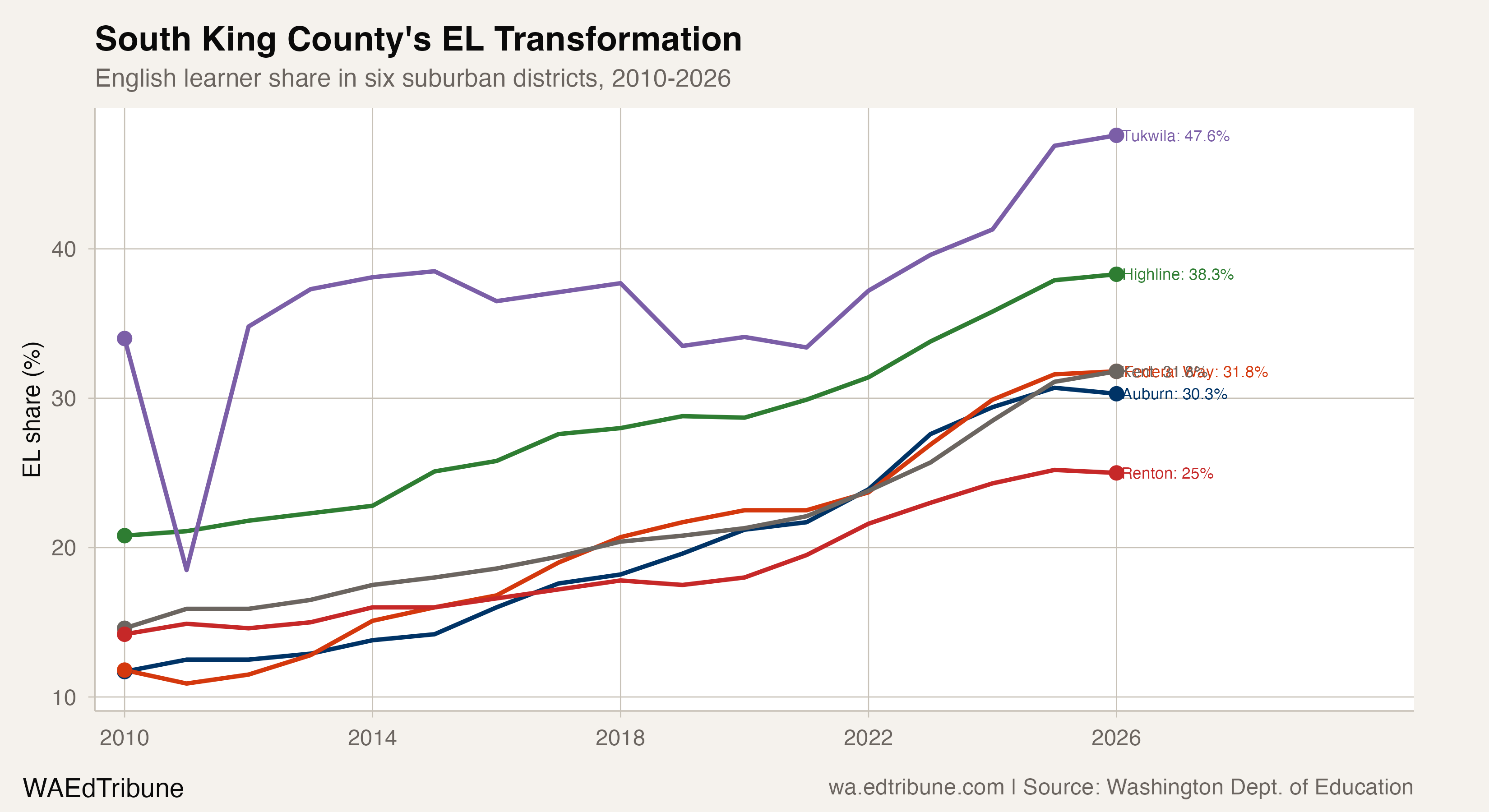
Kent went from 3,937 English learners to 8,160. Federal Way from 2,634 to 7,308, a 177.4% increase. Auburn more than tripled, from 1,684 to 5,482. Tukwila↗ET, already a gateway district in 2010 at 34.0% EL, now stands at 47.9%, making it the only suburban district in Washington where nearly half the student body is learning English.
The post-COVID acceleration
The trajectory was not constant. Three eras define it.
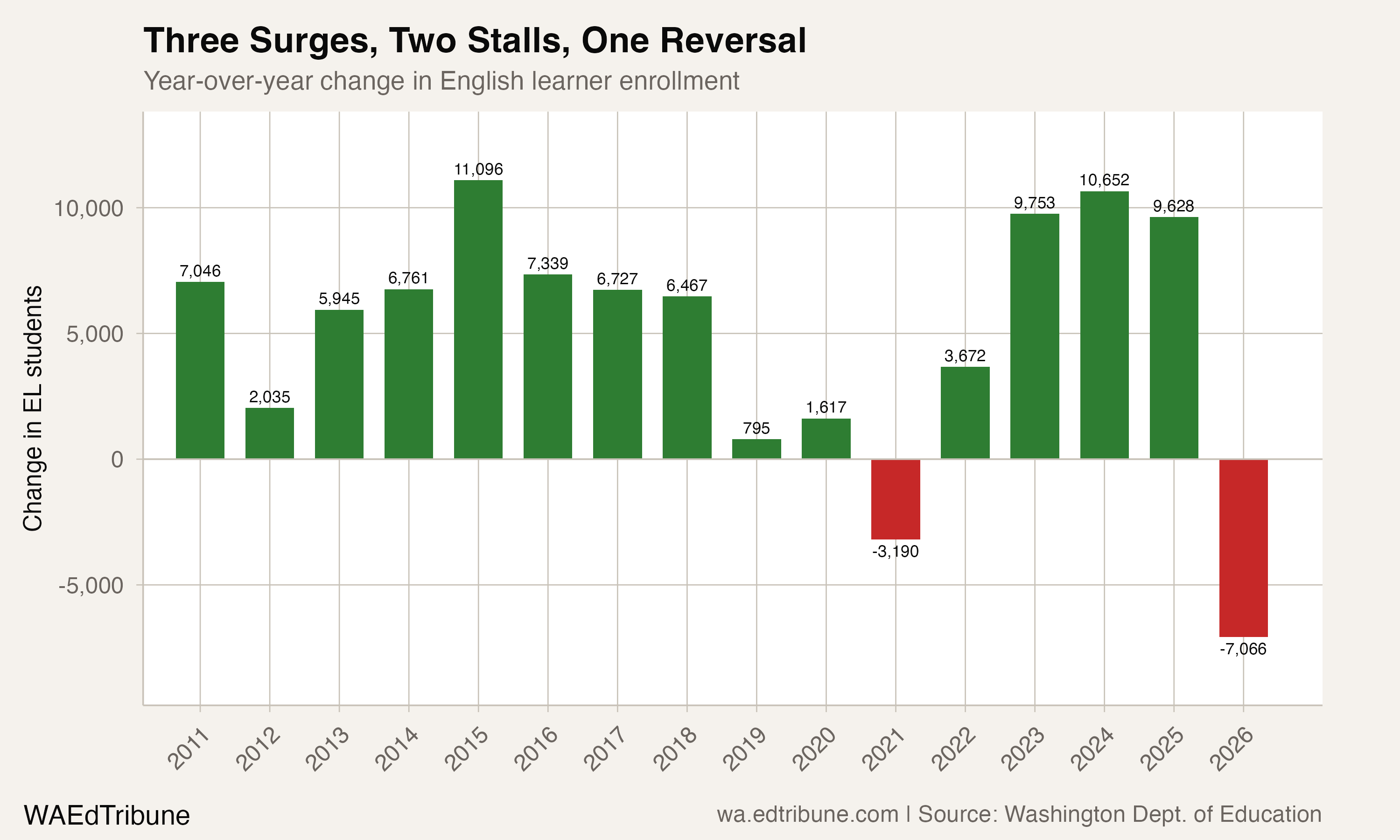
From 2010 to 2015, the state added 32,883 English learners, averaging more than 6,500 per year. Growth then decelerated from 2015 to 2019, adding 21,328 over four years. The COVID period from 2019 to 2022 nearly froze the count, with a net gain of just 2,099 students across three years, including a 3,190-student loss in 2021.
Then the trajectory broke upward. Between 2022 and 2025, Washington added 30,033 English learners in three years, roughly 10,000 per year, the fastest sustained growth in the 16-year dataset. This post-COVID surge pushed the EL share from 12.5% to 15.1%.
The 2025-26 school year stalled that momentum. The count slipped by 1,001 students, from 166,538 to 165,537, and the share held at 15.1%. That is the first decline since the pandemic year, but it is less than a third the size of the 2020-21 drop. One district accounts for a large part of it: Kelso↗ET reported 373 English learners in 2024-25 and zero in 2025-26. Whether that reflects actual student departures, reclassification, or a reporting change is not clear from the data alone.
A gap that keeps widening
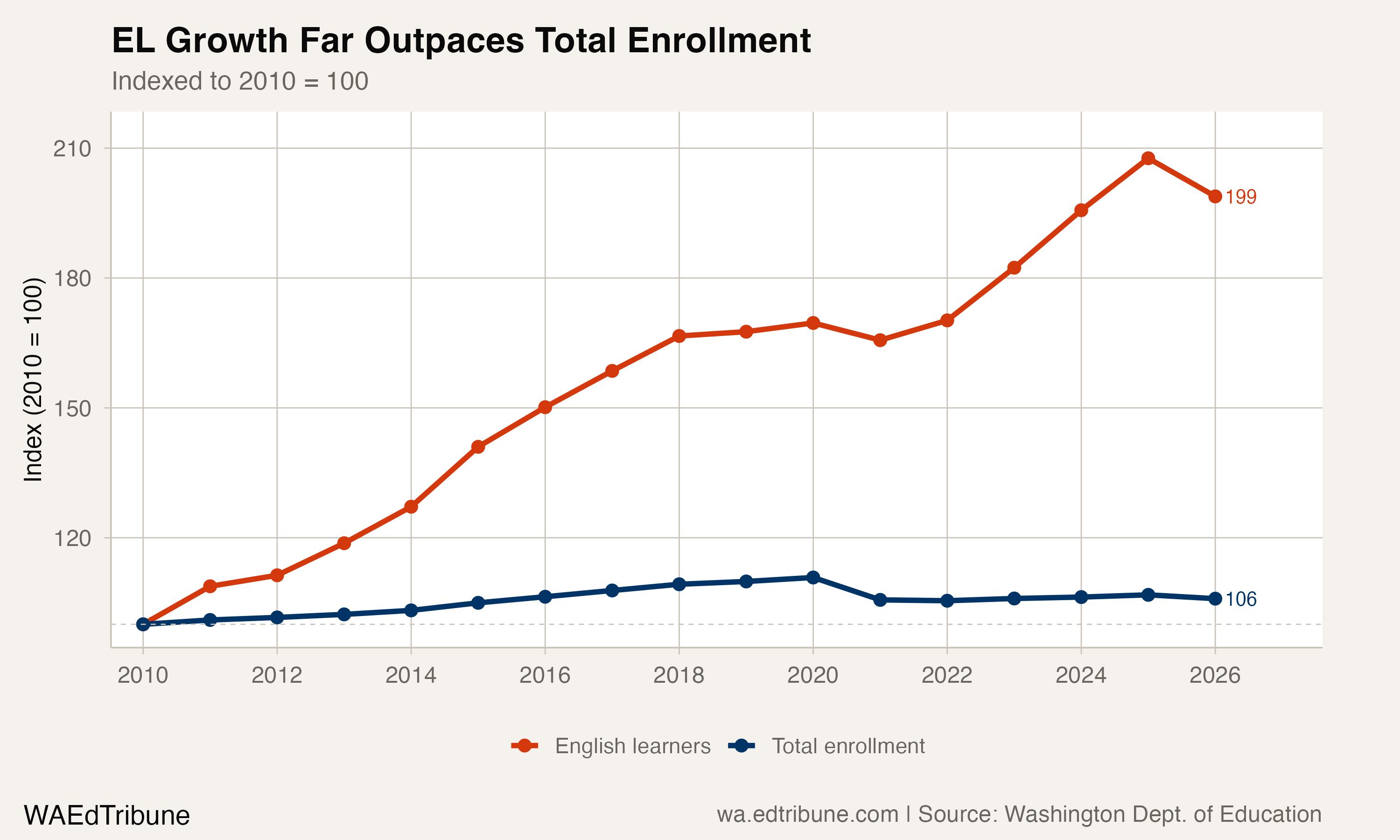
Even with the 2026 dip, the divergence between English learner growth and total enrollment growth is striking. Indexed to 2010, total enrollment sits at 106, meaning the state has 6.1% more students than it did 16 years ago. English learner enrollment sits at 206, more than double the baseline.
That gap has fiscal and operational implications that compound. Washington's Transitional Bilingual Instruction Program allocates supplemental funding for each eligible English learner based on a prototypical staffing model. But the staffing required to serve these students is harder to fund than it is to calculate. A 2023 joint report by PESB and OSPI found the state would continue to operate at a deficit, failing to produce the 260 to 390 bilingual educators necessary each year through 2025-26.
In many districts, paraeducators provide the majority of bilingual instruction, particularly in smaller and more rural systems. For a district like Yakima↗ET, where one-third of its 5,067 English learners depend on these services, the gap between need and capacity is not abstract.
What moved the needle
Two forces plausibly explain most of the growth, and they are not the same force.
The first is new arrivals. Washington has historically ranked among the top 10 refugee resettlement states, and King County's foreign-born population crossed 500,000 in 2017, with nearly half of the county's population growth since 2010 coming from immigration. Over the past decade, more than 30,000 refugees from over 70 countries resettled in the state through the U.S. Refugee Admissions Program alone.
The second is expanded identification. Reclassification criteria determine not just when students exit EL status but also, indirectly, how long they stay in the count. OSPI updated its exit criteria effective 2024, creating an alternative pathway for students in grades 3-12 who scored between 4.3 and 4.6 on WIDA and earned Level 3 or 4 on the SBA English language arts assessment. The 2026 dip of 1,001 students may partly reflect a reclassification cohort exiting under these new criteria, though Kelso's drop to zero suggests a reporting change is also involved.
The data cannot distinguish between a student who arrived from another country and a student who was already enrolled but newly identified as an English learner. Both show up the same way in the annual count. This means the 106.4% increase over 16 years reflects some unknown mix of actual demographic change and evolving identification practices.
The suburban transformation no one planned for
South King County offers the clearest case study of how this growth reshaped districts that were not historically EL-serving systems.
"What we are seeing here is happening across the country: the suburbanization of the minority population, which also includes the suburbanization of immigration."
Mark Ellis, University of Washington geography professor, in The Seattle Times
Kent, Federal Way, Auburn, and Highline collectively enrolled 11,941 English learners in 2010. In 2025-26, they enrolled 27,997, an increase of 16,056 students, accounting for 18.8% of the entire statewide EL gain. These four districts alone now serve more English learners than the bottom 272 of Washington's 328 districts combined.
The share increases tell the operational story. Auburn went from 11.7% to 30.4% EL. That means a district that once needed bilingual capacity for roughly one in nine students now needs it for nearly one in three. Every hiring decision, every curriculum adoption, every parent communication strategy changed over the span of a decade and a half.
The next release's telling number
The 2025-26 dip was the first decline in EL enrollment since the pandemic year of 2020-21, and it was much smaller. Whether it marks the beginning of a plateau or a one-year pause will be visible in the next statewide data release.
Kelso, the one district that went from hundreds of English learners to zero, bears watching. If those students reappear in 2026-27 counts, its drop was likely a reporting artifact. If they do not, something structural changed.
For districts like Pasco↗ET, where 36.0% of 18,847 students are English learners, the question is not whether demand for bilingual instruction will continue but whether the workforce pipeline can meet it. Washington's teacher preparation programs were producing fewer bilingual educators than needed even before the EL population surged past 150,000. At the current scale, every year of undersupply compounds.
Detailed code that reproduces the analysis and figures in this article is available exclusively to EdTribune subscribers.
Discussion
Sign in to join the discussion.
Loading comments...