Correction (July 21, 2026): The original article called the all-student cohort a count of other classmates even though it includes foster-care students. It also compared four-year and five-year rows that do not represent the same cohort, made an incorrect claim about every other subgroup in the historical panel, and attributed changes to mechanisms the graduation data cannot establish. This version removes those claims and rebuilds every displayed value from the state's current published graduation data.
Washington reported 398 foster-care students in its 2025 four-year graduation cohort. Their graduation rate was 51.3%. The all-student cohort contained 90,315 students, including the foster-care subgroup, and had an 82.6% graduation rate. The difference between the unrounded package rates was 31.4 percentage points.
Among 19 reported subgroup categories in 2025, foster care had the widest gap below the all-student rate. The next widest was 21.7 points for students experiencing homelessness, leaving a 9.7-point difference between the first- and second-ranked gaps.
The Available Trend
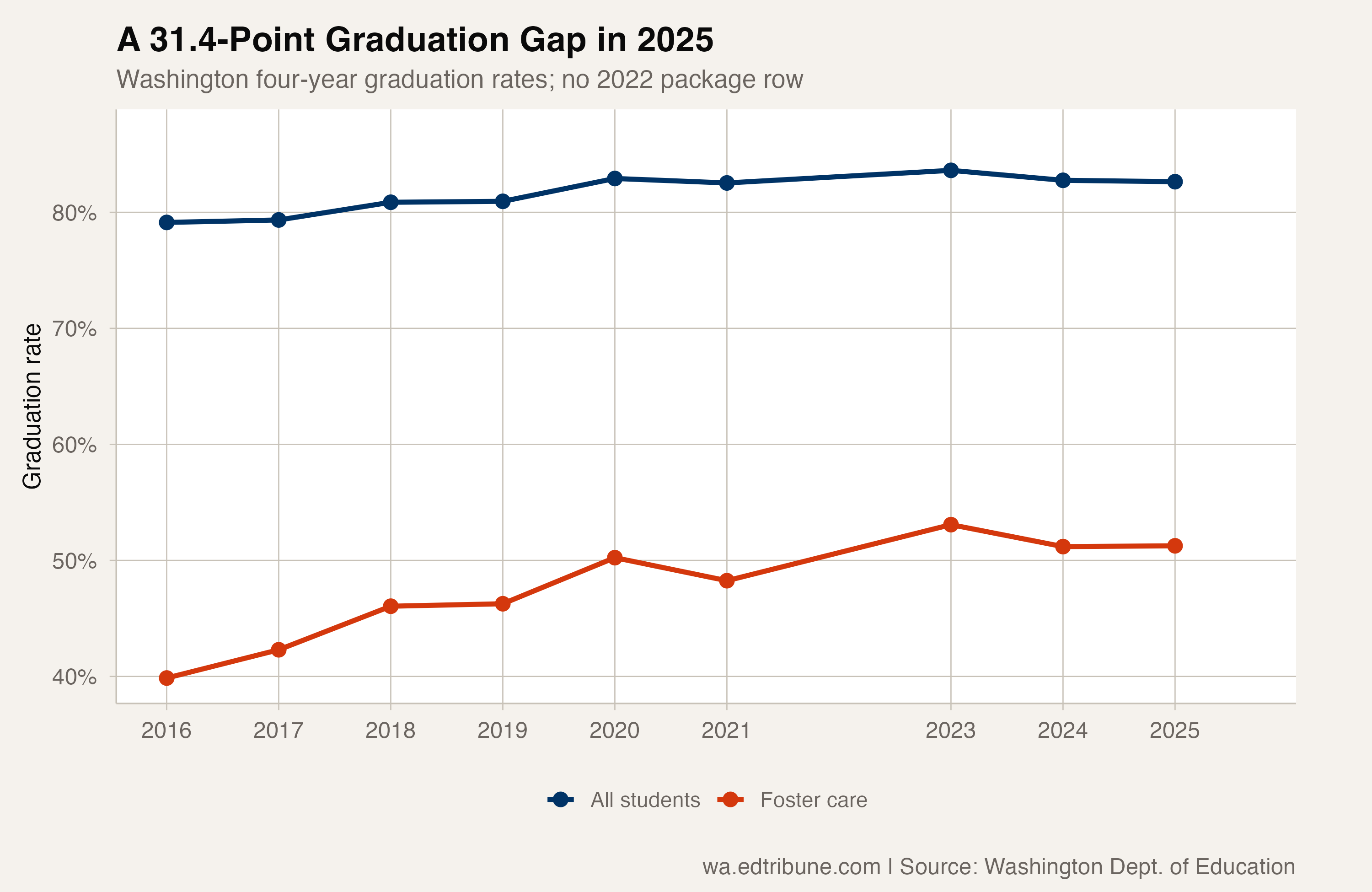
In 2016, the foster-care rate was 39.9% and the all-student rate was 79.1%, a 39.3-point gap. By 2025, the gap was 31.4 points. That is a 7.9-point narrowing across the endpoints.
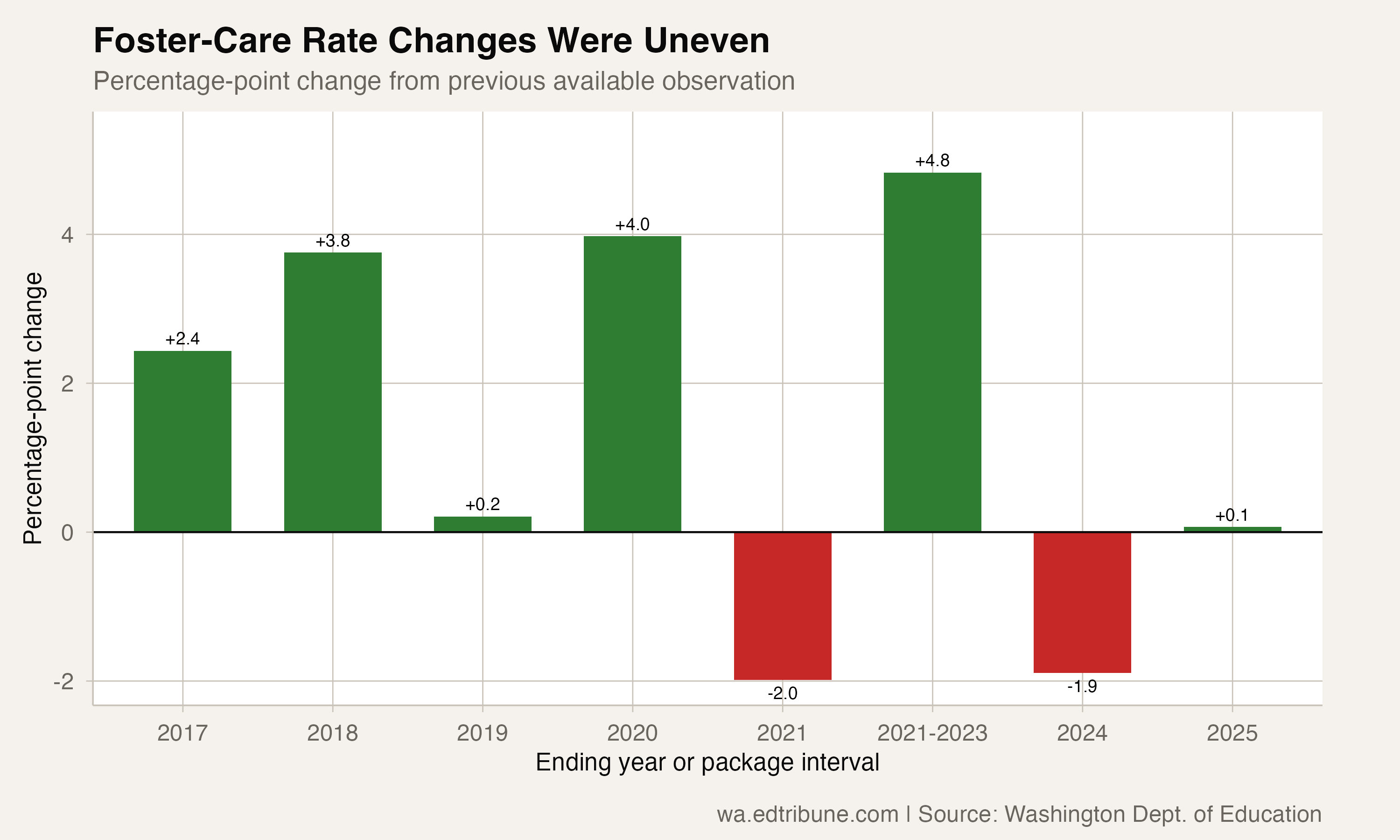
The series has 10 annual observations, from 2016 through 2025. The foster-care rate was 53.1% in 2023, 51.2% in 2024, and 51.3% in 2025. The corresponding gaps were 30.5, 31.6, and 31.4 points.
Across those 3 recent observations, the displayed foster-care rates spanned 1.9 points and the gaps spanned 1.1 points. The data show a narrow recent range; they do not identify what produced it.
A Smaller Reported Cohort
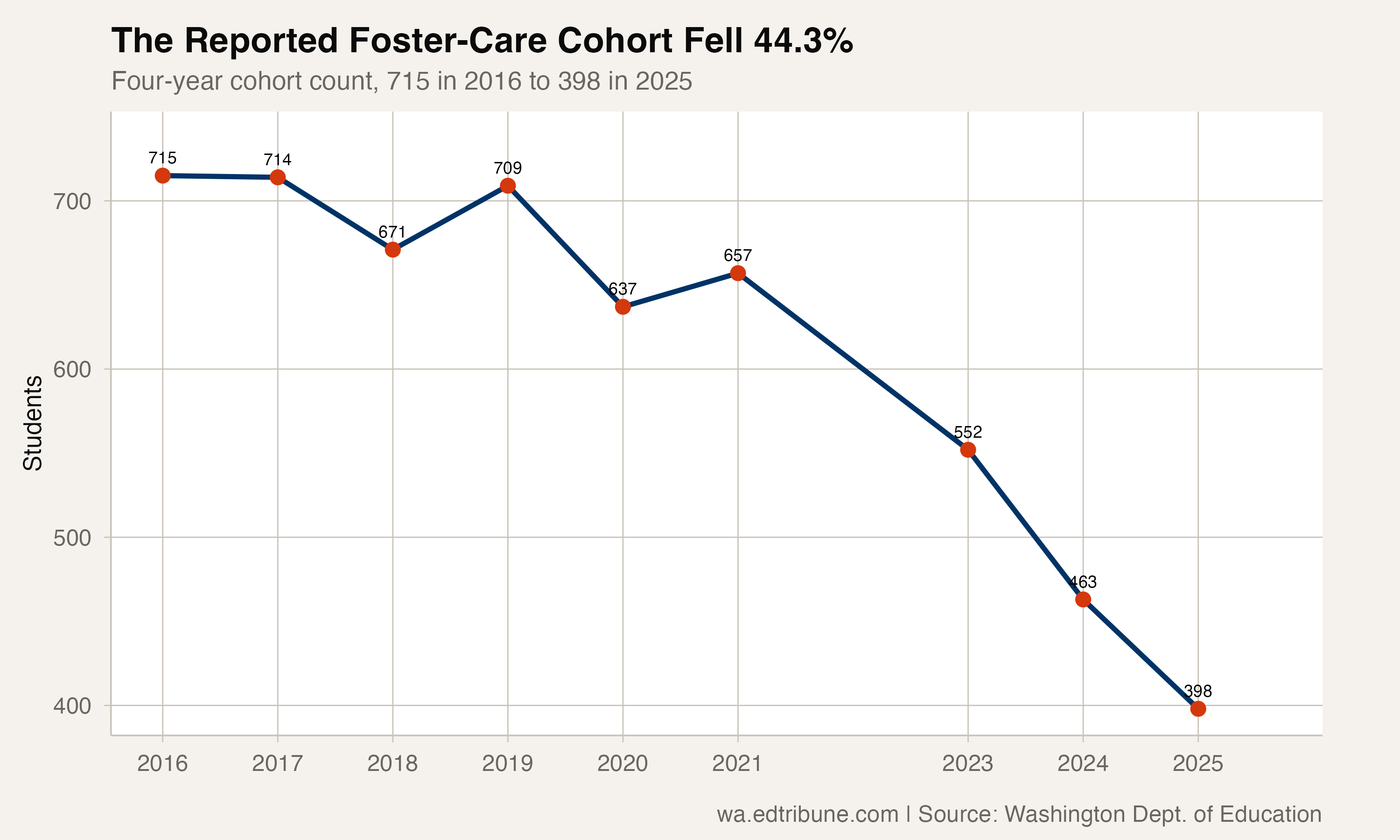
The reported foster-care cohort fell from 715 students in 2016 to 398 in 2025. That was a decline of 317 students, or 44.3%. Over the same endpoints, the all-student cohort increased from 81,041 to 90,315, a gain of 9,274 students or 11.4%.
Those opposite count trends are directly visible in the package. The data do not establish why the foster-care cohort count changed, so the analysis does not assign the decline to a policy, program, or movement of students into or out of care.
The 2025 Comparison
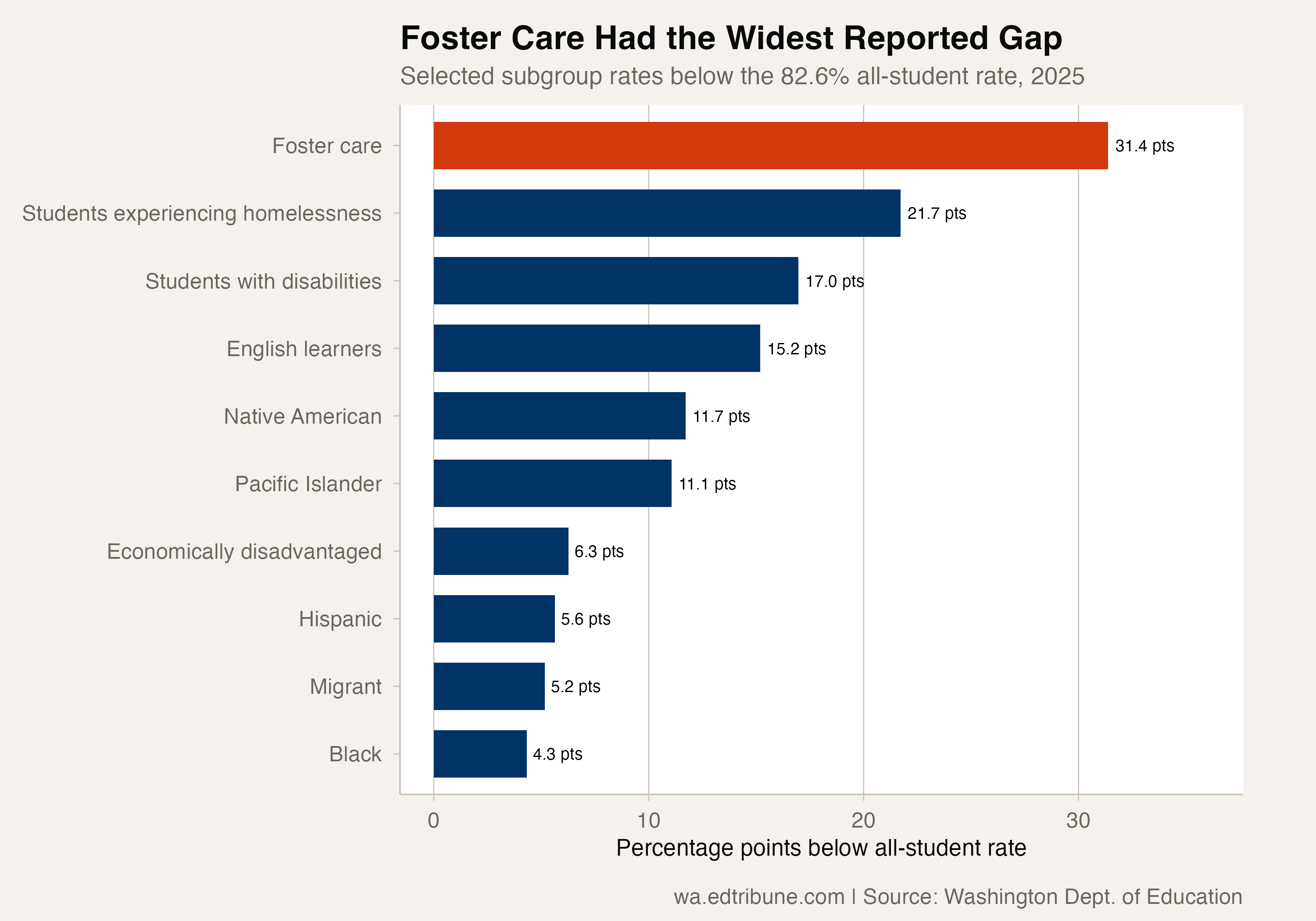
The 2025 gap for students experiencing homelessness was 21.7 points. The gap for students with disabilities was 17.0 points, followed by 15.2 points for English learners, 11.7 points for Native American students, and 11.1 points for Pacific Islander students.
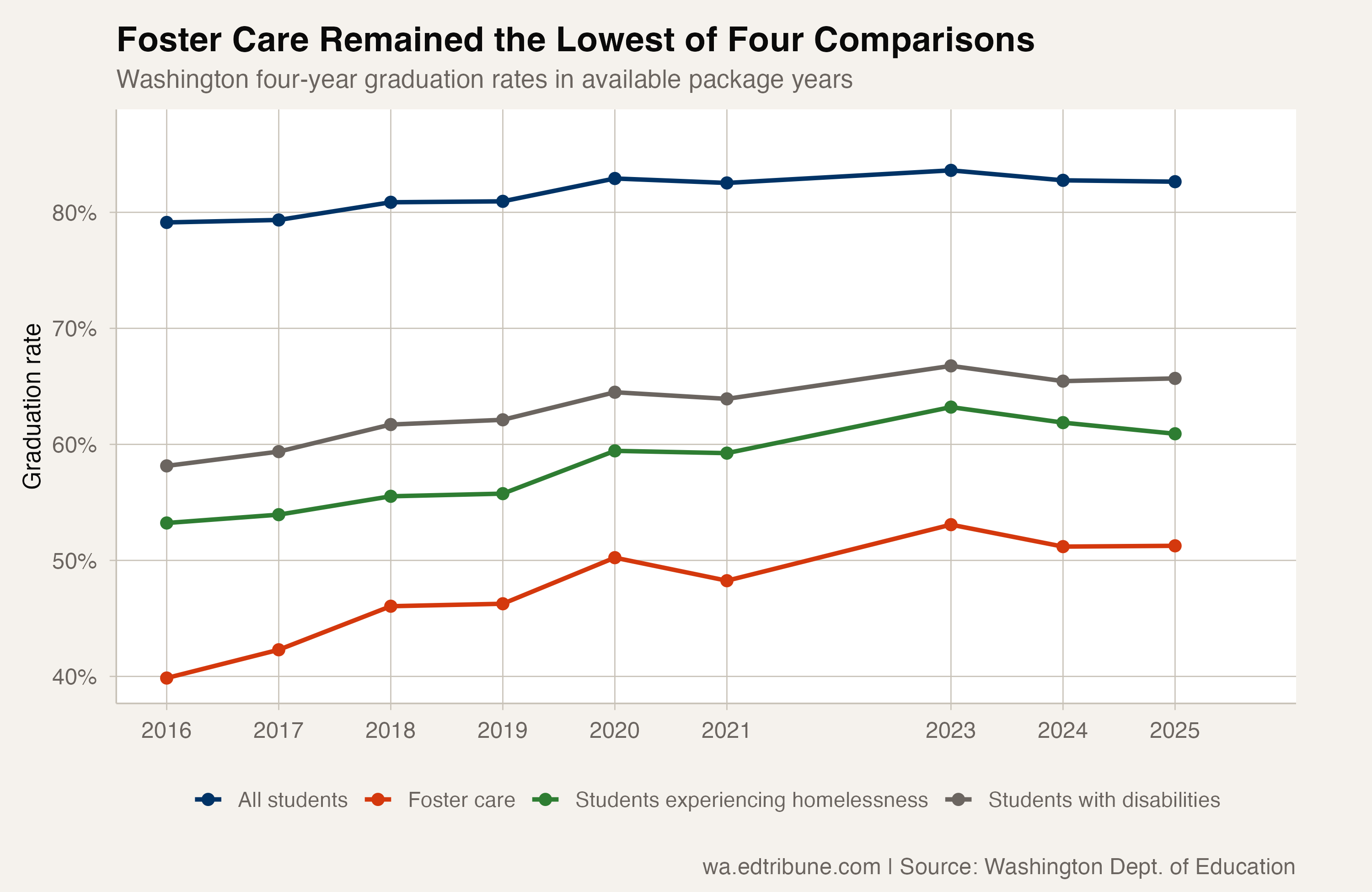
The four displayed populations are separate package categories and can overlap; this comparison does not isolate the effect of any one student characteristic. What it does establish is the reported rate and gap for each category. In 2025, the foster-care category remained the lowest of the four displayed rates and the farthest below the all-student benchmark.
Detailed code that reproduces the analysis and figures in this article is available exclusively to EdTribune subscribers.
Discussion
Sign in to join the discussion.
Loading comments...