Doug Dearden spent more than a decade and a half as superintendent of Trout Lake School District↗ET and retired in 2019. On July 1 he started again, in the same job, in a district of 206 students at the foot of Mount Adams.
"I am excited to be serving in this capacity," he said in written responses to The WAEdTribune. He retired in 2019 after a long run in the same seat, he wrote, but feels "blessed to have the energy and time to do the best job I can for the students, staff and community of Trout Lake."
The role is permanent, not interim, and he confirmed the July 1 start date directly. He succeeds Jerry Lewis.
Trout Lake is one of Washington's smallest districts, and its enrollment record over the past decade is not the steady decline the phrase "small rural district" tends to summon. The district enrolled 221 students in 2014-15, climbed to 241 by 2017-18, and then lost 31 students in the single year ending in 2020-21, a drop of about 14 percent. Nothing about that year was normal anywhere, but in a district this size it meant the equivalent of an entire grade level leaving at once.
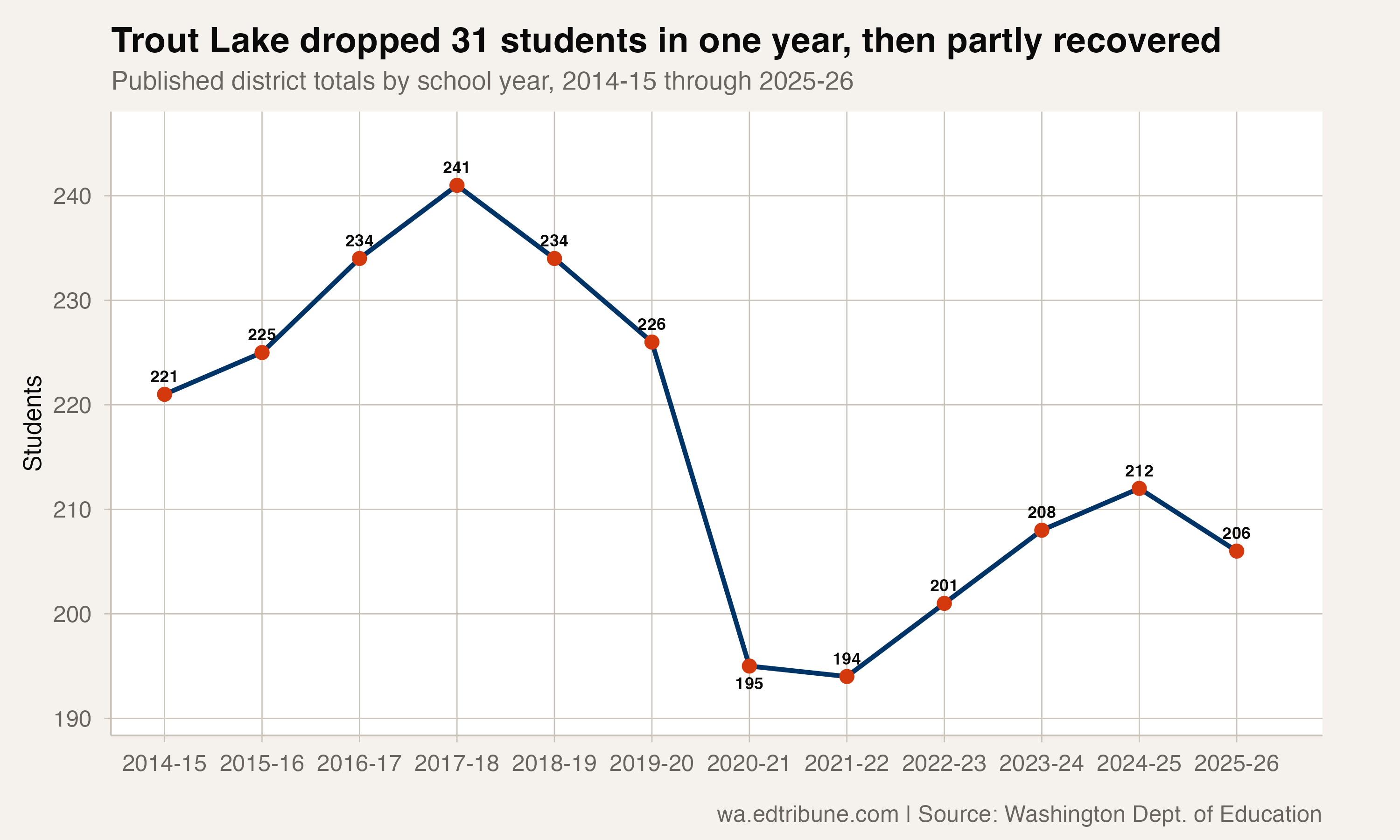
Then it came back. Enrollment bottomed at 194 in 2021-22 and rose in each of the next three years, reaching 212 by 2024-25, recovering a little more than a third of what the district had lost from its peak. In 2025-26 it slipped again, to 206, six students lower than in 2024-25.
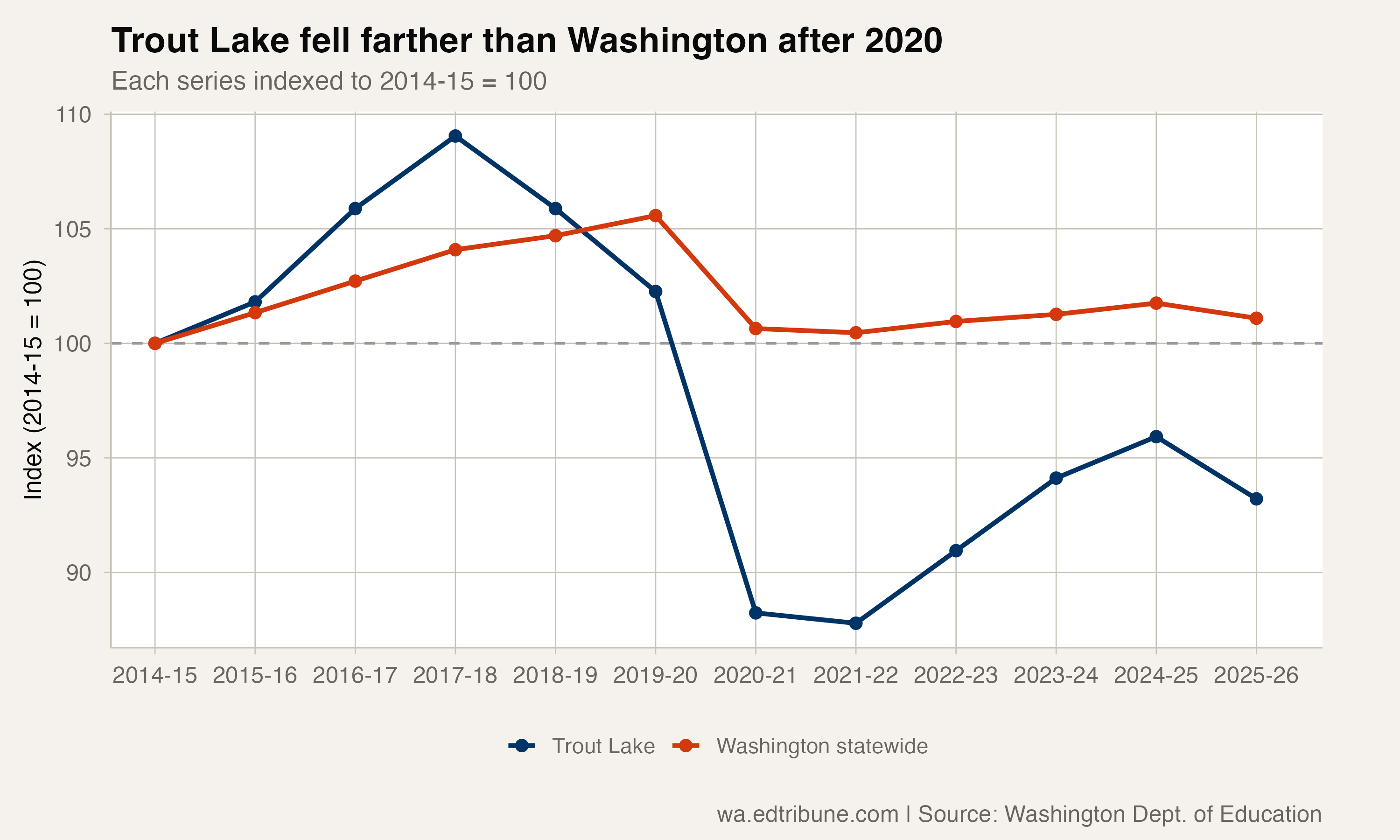
Measured end to end, Trout Lake has 15 fewer students than it did in 2014-15, a decline of about 7 percent over a stretch when Washington's statewide enrollment grew about 1 percent. That is the landscape Dearden is stepping back into, and it is a different one from the district he left.
What he is watching
Asked what trend he is following most closely, Dearden did not name a budget line. He named where his high school students go.
"We are seeing high school students leave a traditional high school education to many alternative choices including online schools, Running Start, and work based programs," he wrote. "It is difficult for small rural high schools to keep up with all the choices and build programs that will keep students interested and engaged, but we are going to give it a great shot." He added that more Trout Lake families are choosing home-based instruction.
The state's published enrollment files cannot confirm why any particular student leaves. What the files can show is the size of the high school itself, and that number has not shrunk.
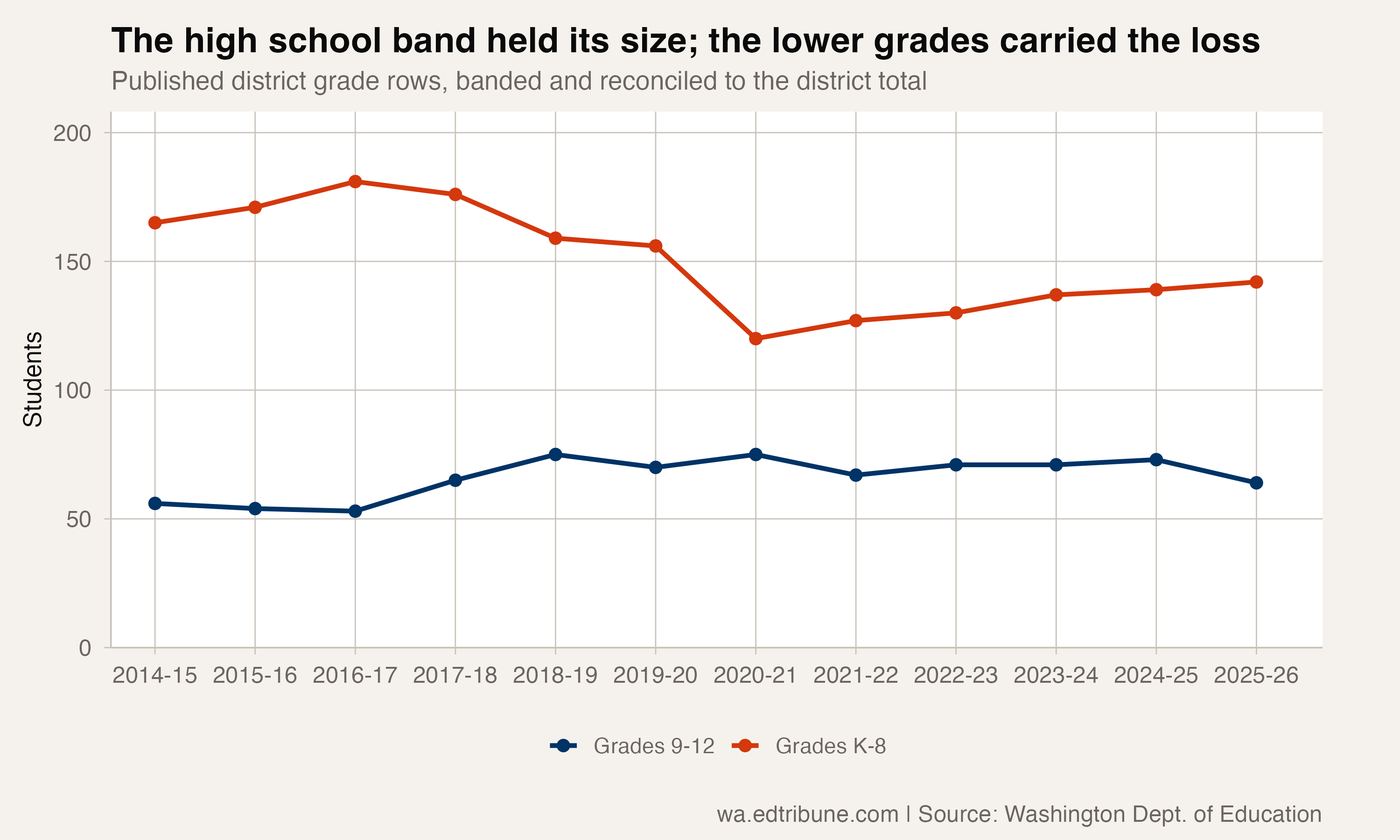
Trout Lake's high school grades held 56 students in 2014-15. They hold 64 in 2025-26, while over the same span the elementary and middle grades fell from 165 to 142. The high school's share of the district has grown from about a quarter to about a third. The losses of the past decade sit in the elementary and middle grades, not the high school.
Shown those counts, Dearden supplied the part the file cannot hold. Students who leave for Running Start or online courses "are still counted in our FTE, but not as present in our building," he wrote. "We miss them!"
That is the gap between a hallway and a spreadsheet. A Running Start junior is a student the district still counts and no longer teaches, so the departure he is describing is one that a headcount is built not to register. In a district where the entire senior class is 20 students, a handful of those students is a visible absence and a statistical non-event at the same time.
He also named what moved the younger grades. At the district's high-enrollment years, he wrote, Trout Lake was drawing "a lot of" elementary and middle school students who choiced in from other districts, and he said that inflow has decreased since then.
Measured from the district's 2017-18 enrollment peak rather than from 2014-15, the K-8 grades fell from 176 students to 142, a loss of 34. Dearden's account is suggestive context for that decline, but Washington's enrollment file carries no transfer or choice field and cannot confirm the mechanism.
What the grade bands add on their own is where the district's long-run pressure comes from next: 11 kindergartners enrolled in 2025-26, against 20 seniors.
The priorities
Dearden listed five, and the one he put the most words behind was about ambition rather than survival.
"I have always believed while Trout Lake is small, rural, with limited staff, that we should strive to provide an education that rivals what any student could get in any urban or suburban setting in the state of Washington," he wrote. "With the support of the community and a wonderful and caring staff you can investigate the many unique opportunities that our students have."
The others: a positive environment supporting the whole child, "rooted in the core beliefs that all have value, and all have strengths that can contribute to the life of others"; hiring, retaining and developing staff committed to teamwork and collaboration, a group he described in his Aug. 15 written response as "currently excellent and experienced with a good mixture of creativity and talent"; responsible management of school resources and taxpayer dollars; and building relationships with the community.
It is a list that reads like someone who already knows the building. That is the unusual feature of this transition: there is no learning curve of the customary kind, and no incoming leader working out who to trust. There is instead a leader who knows exactly what the district was in 2019 and is inheriting a version of it that has been through a 31-student shock, a partial recovery, and a fresh dip.
What he does not inherit is a settled answer on the high school. The alternatives he described are not going away, and a district with 64 students across four grades has limited room to build competing programs. His stated plan is to try anyway.
Enrollment counts come from the Washington Office of Superintendent of Public Instruction's published enrollment reports. Quotations and the details of the appointment were supplied directly by Dearden to The WAEdTribune.
Detailed code that reproduces the analysis and figures in this article is available exclusively to EdTribune subscribers.
Discussion
Sign in to join the discussion.
Loading comments...